
Sizing
What Size Dumpster Do I Need in Brockton, MA? A Sizing Guide
Roll-off sizing for Brockton: what each of the five sizes actually suits here, why a 48-inch frost line puts a full basement under nearly every house and an extra floor into every cleanout, which loads run out of weight before they run out of room, and why the wallboard has to come out of a gut load before transfer.
Most sizing calls open with a project name. "We are clearing out my mother's house off Montello, what size do I need?" There is no answer inside a project name, but in Brockton there is a good first question the national guides never ask: does the house have a full basement, and how full is it? Here the answer is nearly always yes, and fuller than the caller thinks.
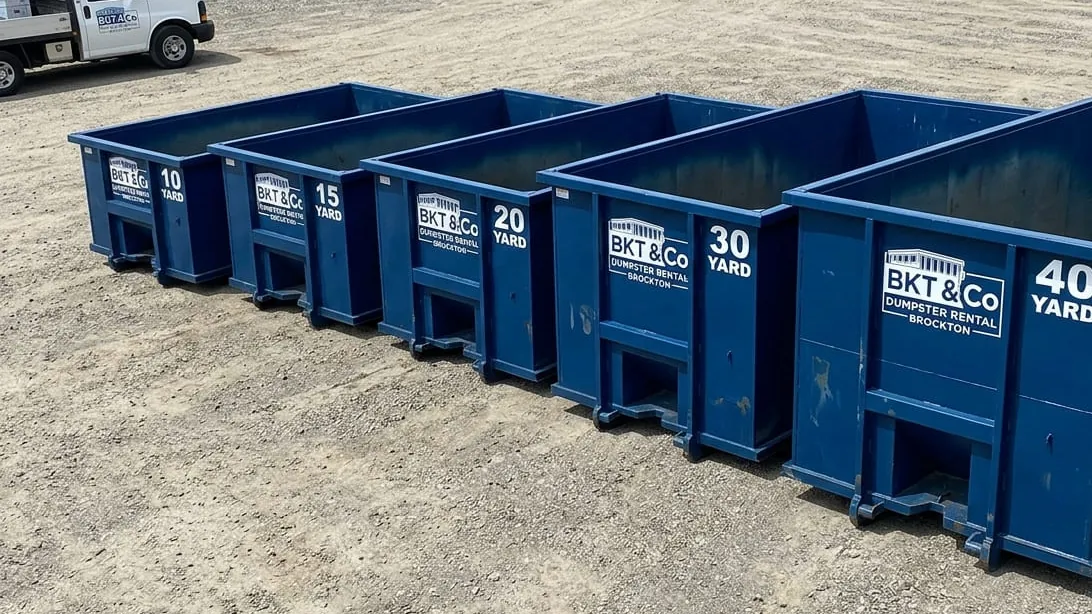
Brendan Teixeira started BKT & Co Dumpster Rental Brockton with one truck and four cans in 2011 and still answers the phone. The yard is at 1109 Montello Street, a short run out to Route 24. We run 10, 15, 20, 30 and 40 yard roll-offs, all five with their dimensions on the dumpster sizes page.
Start with the frost line: 48 inches, and what it built
The Massachusetts residential code, 780 CMR 51.00, Table R301.2, sets the frost line depth at 48 inches statewide. Footings must reach below it or the ground lifts them, and once a builder has dug four feet, the extra depth for a full cellar is close to free. That is why pre-war New England housing is essentially all full-basement housing, and why a Brockton cleanout has a whole extra floor a slab-market guide never counted.
Then look at what Brockton built. The Massachusetts Historical Commission puts the city's most intensive residential construction in the 1870–1915 late industrial period, when the shoe factories were running flat out. Two-family dwellings dominated, and three-deckers proliferated after 1895, particularly in Montello and along Main Street south toward Campello. Those houses have a full cellar under them and a floored attic over them.
The basement is the cleanout. The workbench, storm windows, bicycles, canning jars, boxes that went down when someone moved in and never came back up — then the attic on top. A slab-market calculator assumes a garage, a spare room and an attic; here you add a floor, and it is usually the densest one, which is why we wrote up basement and attic cleanouts in Brockton room by room. The rule: on a full-house cleanout in the pre-war stock, size one step up from what a national calculator returns. On dense debris it inverts.
Weight sets the size on some loads, volume on the rest
Every roll-off has two ceilings: the space inside the box, and what the truck can legally lift off your driveway. Most household material runs out of space first. Two Brockton loads run out of weight first, and early.
- Foundation and excavation spoil. Because footings go to 48 inches, a foundation repair, an addition, underpinning or a bulkhead replacement produces spoil out of proportion to the project. Wet spring soil from a four-foot trench is the heaviest thing we take off a residential drive, and a pile that looks modest on a tarp puts a 10 at payload spread flat across the floor.
- ABC rubble: asphalt pavement, brick and concrete. Old walkways, a cracked front step, a chimney down to the roofline, a section of driveway. Rubble nests as it settles, so the box keeps taking weight after it stops looking hungry.
Both load the same way: flat and low, spread across the floor, never mounded. A mounded box cannot be tarped and cannot legally leave. On dense material the rule reverses: when two sizes both look plausible, take the smaller box and plan a swap.
ABC carries a second constraint unrelated to weight. Asphalt pavement, brick and concrete have been banned from disposal since 1 July 2006 under 310 CMR 19.017, along with ferrous and non-ferrous metal. Clean rubble has a recycling route, and the way to keep it open is to run it as its own container with no wood, plastic or trash in it.
The sorting instruction that changes your size
Two things are true at once here, and most sites get one of them wrong. First: a mixed load is legal. You may fill one roll-off with mixed demolition debris, and no job-site source separation is required. What you cannot do is send it to a hole in the ground — it has to reach a permitted C&D processor or transfer station operating under a MassDEP-approved Waste Ban Compliance Plan, held to a rising Process Separation Rate, 20 percent for 2025 and 2026. Only 29 of the state's 396 handling facilities are C&D processors, so the destination matters.
Second, and this one changes the container you order: clean gypsum wallboard has to come out of the load before transfer. Banned since 1 July 2011, and MassDEP requires facilities to separate it rather than pass it through, so processors price or refuse loads with loose board. On a kitchen or bath gut, plan for it up front: a separate pile, or a small second box beside the main one. A 20 for the gut plus a 10 for the board beats one 30 turned away at the gate.
Two more change what fits in the box at all. Mattresses and textiles have been banned outright since 1 November 2022 and cannot ride in the container. Neither can appliances, metal, cardboard and recyclable paper, yard waste, ABC, or cathode ray tubes. The full list, and where each material goes here, is in our Massachusetts waste ban guide; the bans come from MassDEP.
What the city takes, and where it stops
Curbside collection is capacity-limited: one barrel per family unit per week, 50 pounds maximum, with anything beyond that requiring official green Brockton pay bags at $5 per roll of four. Recycle carts are $55. Bulk is one free item per unit per week, booked two business days ahead, then $20 each for a mattress or box spring, a couch or loveseat, a TV or monitor. Only residents of one- to five-family homes who pay the trash fee are served; condominiums and businesses are not.
Then the sentence that defines this business. The city does not collect construction debris. For items outside the program — the City's own list names property cleanouts, kitchen cabinets, sheetrock, bathtubs, pipes, tree stumps, rocks, soil and asphalt — residents "must hire private haulers." That list is the roll-off market here, written by the City itself. One bath stripped to the studs is eight to twelve cubic yards and a basement clear-out is twenty or more: not a 50-pound barrel job at any speed. Details are on the City of Brockton site.
The five sizes and the Brockton job each one suits
10 yard: the heavy specialist
In many markets the 10 is an afterthought. Here it works every week on foundation spoil, chimney and step rubble, and separated wallboard. The low walls stop you loading past what the truck can hoist. A 10 yard container loaded flat with wet spoil is finished when a neighbor would call it a third full.
15 yard: one room, or one unit
The workhorse for single-room work and rental turnover: one bath or one kitchen out of a Campello two-family, or one apartment emptied between tenants. The 15 yard container also fits driveways a 20 will not.
20 yard: the Brockton default
If this city has a standard box, this is it. A 20 yard container handles a basement clear-out, a garage and attic together, a multi-room remodel, a single-layer tear-off loaded flat, or storm limb wood after a nor'easter — provided nothing dense goes in it.
30 yard: the whole house
A 30 yard container is for whole-property work: an estate clear where cellar, attic, first floor and garage all empty at once, a full gut of one side of a two-family, or a three-decker turnover. Taller walls suit bulk, not weight. A 30 filled with dense material stays where it is.
40 yard: bulky and light only
The 40 yard container has a real place and a narrow one: siding and trim off a re-side, a porch or deck coming down, light bulk out of a multi-unit refresh, storm wood after a big blow.
| Container | Rough footprint | Typical payload | Pickup loads | The Brockton job |
|---|---|---|---|---|
| 10 yard | 12 ft x 8 ft x 3.5 ft | 1 to 2 tons | 4 to 5 | Foundation spoil, chimney and step rubble, separated wallboard |
| 15 yard | 16 ft x 8 ft x 4 ft | 2 to 3 tons | 6 to 7 | One bath or kitchen, one apartment turnover, tight driveway |
| 20 yard | 22 ft x 8 ft x 4.5 ft | 3 to 4 tons | 8 to 10 | Basement clear-out, multi-room remodel, single-layer tear-off |
| 30 yard | 22 ft x 8 ft x 6 ft | 4 to 5 tons | 12 to 14 | Whole-house estate clear, full gut, three-decker turnover |
| 40 yard | 22 ft x 8 ft x 8 ft | 5 to 6 tons | 16 to 18 | Siding, decking, porch teardown, light bulk from a multi-unit |
Use the pickup column as the sanity check: a full-size bed loaded level is a bit over two cubic yards, so the 20 that sounds enormous on the phone is eight or nine truckloads — one weekend of a cellar.
Two-families, three-deckers and turnovers
Brockton is more of a two-family city than a pure three-decker city, and that shapes the sizing. A single-unit turnover — carpet, appliances out to the metal pile, cabinets, one bath, a tenant's leftovers — is a 15 or a 20. What catches owners out is that it becomes a cellar job too: the shared basement holds both households' storage, and the moment a container lands on the driveway everything comes up the bulkhead.
Three-deckers, concentrated in Montello and down the Main Street corridor toward Campello, are different arithmetic: three kitchens, three baths, three sets of stair carpet, one common cellar. A full turnover is a 30, or a 20 swapped twice if the driveway will not hold a 30. Remember the age: pre-1978 housing triggers the Massachusetts Lead Law, and suspect asbestos-containing material must be surveyed by a licensed inspector under 310 CMR 7.15 before demolition. We cannot take asbestos in a container, ever.
Roof tear-offs: count squares and layers
Roofers count in squares, one square being 100 square feet of roof. Two numbers size the box: how many squares, and how many layers are coming off. A Brockton two-family roof with its pitch, dormers and overhangs runs past what the footprint suggests, and a single-layer strip off it is a 20 yard load, flat. Two layers is close to double the weight, and because the box is limited by payload rather than space, the answer is staged pulls, not a taller container. Add underlayment, nails, flashing, rotted decking and the ice barrier, which is code here. One clarification: asphalt shingles are not on the Massachusetts ban list, only asphalt pavement is, though shingles separate well because they have a real recycling route.
The size that fits is the size that fits the driveway
A box that cannot reach the spot is the wrong box whatever the math says. The truck needs:
- Roughly 60 feet of straight approach to set a 20 or larger. The truck rolls the container down the rails; it cannot pivot a box into position.
- About 10.5 feet of width the whole way. This is the common constraint in Montello and Campello, where driveways run tight between two two-family houses.
- Twenty feet or more of overhead clearance for the hoist arm — usually a maple, oak or white pine that has grown over the drive since the house was new.
- Protection boards under the rails and wheels on every set, standard on our trucks. Asphalt takes an impression and keeps it.
Then the permit, which surprises people from other states. 527 CMR 1.00, the Massachusetts Comprehensive Fire Safety Code, lists rubbish containers greater than 6 cubic yards as a permitted activity, issued by the head of the fire department. Every standard roll-off exceeds six cubic yards, so a container left overnight anywhere in Massachusetts, on your own driveway and not just in the street, falls under it. One delivered and removed within a single business day is exempt. Call Brockton Fire Prevention on 508-583-2933 to confirm how they handle it for your address.
The same chapter is why the setback figure you find online is wrong for this state. Massachusetts departments enforce 10 feet from combustible walls, openings and overhangs, not the 5 feet quoted in most national dumpster content. Containers also stay 20 feet clear of an intersection, 10 feet clear of a hydrant, and off apparatus access and building egress. Ten feet of clearance on a narrow Brockton driveway can be the reason a 30 becomes a 20. The rest is in our guide to dumpster permits in Brockton.
Winter shrinks all of that. Brockton sees 137.5 nights a year at or below freezing and roughly 30 to 45 inches of snow in a normal winter, and snowbanks and plow windrows eat the width a driveway had in September — a spot that took a 30 in October takes a 20 in February. Frost also limits excavation, which is why foundation work clusters in the spring thaw, the same weeks the cellar is wettest.
Tell us what is in it
Two rules cover most of what goes wrong. On a dense load, go smaller and swap. On a bulky light load, go bigger the first time. And because Massachusetts holds the hauler liable alongside the generator, we ask what is going in the box before we size it — a load with mattresses or loose wallboard in it becomes a problem at the gate for both of us.
BKT & Co has worked out of the yard on Montello Street since 2011. Tell Brendan what you are emptying, whether the cellar is part of it, and what the approach looks like, and he will size it before a truck leaves. Call (508) 436-2303 or use our contact page.
Questions this guide did not answer? Call (508) 436-2303. We would rather spend two minutes on the phone than have you order the wrong container.