Pricing
Dumpster Rental Cost in Brockton, MA: What Actually Moves the Number
In Brockton the quote is built from five variables, and what goes in the box matters more here than almost anywhere else. Here is why a mixed C&D load has to go to a processing facility, what the waste bans do to a price, and where the city's free routes genuinely beat renting a container.
Most pricing calls open the same way. Somebody has a figure from a national chart and wants to know what it means in Brockton. It means very little here. Massachusetts prices waste differently from almost anywhere else, and two identical containers on the same Montello street can land far apart depending on what goes inside them.
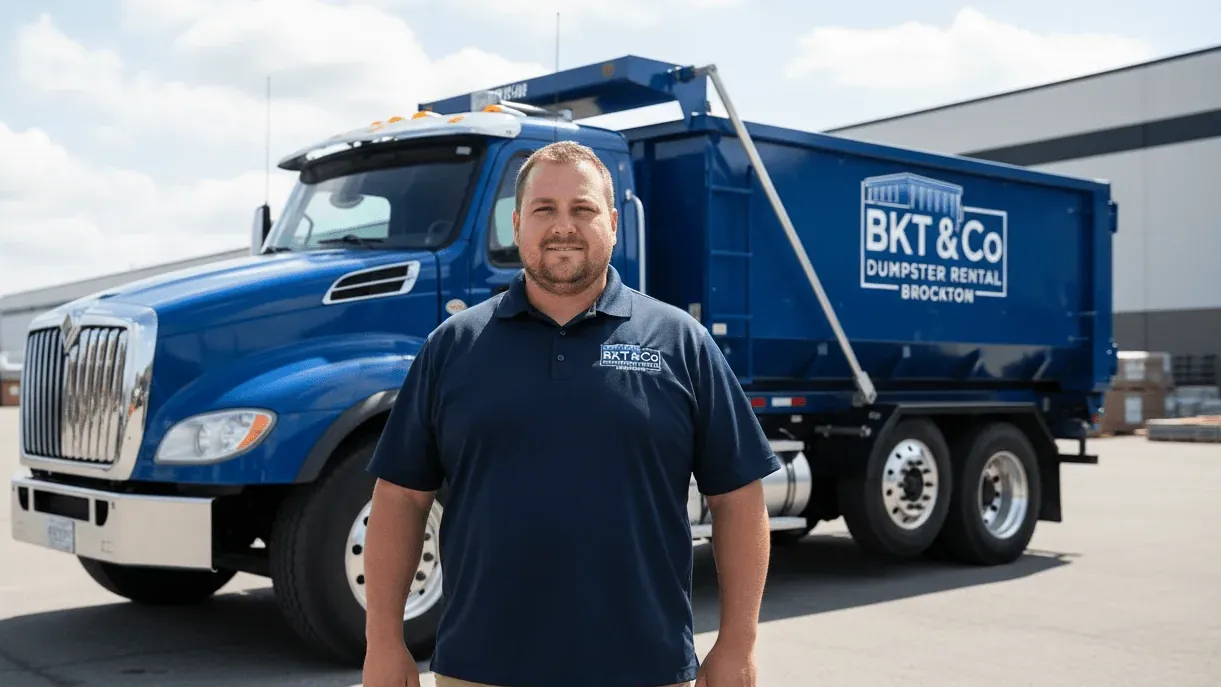
The arrangement is simple. You describe the job, we quote one flat figure over the phone, and it stays put. Brendan Teixeira started with one truck and four cans in 2011 and still answers the phone, so it is a two-minute conversation, not a form and three days of email. There is no price for our service on this page, because a number written for a stranger's job is a guess. What follows is the five variables behind the conversation.
The five things that actually move a quote
- Size. Which box the job needs, and whether it is one pull or two.
- What is going in it. The big lever in this state, and most of this page.
- How long you keep it. The period you agree, and whether the job runs past it.
- Where it has to sit. A 1900 two-family with a shared drive is not a corner lot off Route 24.
- What is in the load that legally cannot be. Here that list is long, and enforced.
Size: start with the material, not the room
We run 10, 15, 20, 30 and 40 yard roll-offs, and the size comparison sets out what each holds. Avoid describing a job by room. A third-floor clearout in a Campello three-decker full of cardboard and old furniture is a volume job and wants a big box. A cellar with a broken concrete floor patch is a weight job and wants a small one, loaded low. The Brockton sizing guide works through the common jobs.
What is going in it: why Massachusetts is the expensive part
A mixed load is legal. Where it can go is not open
Everywhere else this question is about weight. Here it is weight and destination, and plenty of sites get the destination wrong. You may fill a single roll-off with mixed demolition debris in Massachusetts. What you cannot do is send that container to "the dump."
A mixed load must go to a permitted C&D processing facility, or a transfer station, holding a MassDEP-approved Waste Ban Compliance Plan that provides for diversion. Processing is not tipping: the material goes onto a picking line and the banned and recoverable streams come off before anything is disposed of. That costs more than tipping, and it is priced into every C&D load in this state.
The Minimum Performance Standard, and why it keeps rising
The processor cannot do a token job either. It is bound by a Minimum Performance Standard — a diversion rate it is fined for missing, rising on a published schedule:
| Period | Required diversion rate |
|---|---|
| 2020–2024 | 15% |
| 2025–2026 | 20% |
| 2027–2029 | 23% |
| 2030 onward | 25% |
A facility that misses it cannot dispose of the residual; it has to forward that to a compliant facility, which costs again. That sits inside every gate rate in the Commonwealth. The Massachusetts construction debris guide covers what a processor does with a mixed load.
The capacity squeeze underneath all of it
The reason is not paperwork. MassDEP's 2024 figures: 6,220,000 tons disposed, only 7.6 percent to in-state landfill, 47.7 percent to in-state combustion, and 44.7 percent net export — 2.78 million tons moved out of the Commonwealth to be buried elsewhere. Nearly half of what this state throws away leaves it, and every mile is in the price.
The 2030 Solid Waste Master Plan is blunt about what comes next: in-state landfill capacity "is projected to decline to virtually zero by the end of the next decade." There are 15 active landfills left statewide. Disposal here is expensive because the state is running out of places to put things, and no honest quote can pretend otherwise — see MassDEP.
What legally cannot be in the load
Massachusetts bans more material from disposal than almost any state, under 310 CMR 19.017, and the rule covers transfer for disposal too, so the ban bites at the gate. These turn up in real roll-offs and create a surcharge, a sorting charge or a turn-away:
- Mattresses and textiles, since 1 November 2022. MassDEP on the first: "there is no acceptable amount of mattresses."
- Appliances and white goods. Refrigerators, freezers, washers, dryers, water heaters.
- Ferrous and non-ferrous metal. Radiators, cast iron waste pipe, steel bulkhead doors.
- Cardboard and recyclable paper.
- Cathode ray tubes, CRT televisions and monitors.
- Tires and lead-acid batteries.
- Yard waste and leaves. Brush, sod and leaf litter.
- Asphalt pavement, brick and concrete — ABC rubble. Its own stream, its own container.
- Clean gypsum wallboard, with a twist: MassDEP requires a facility to remove it from a mixed load before transfer, so processors price or refuse loads with loose board. Keeping wallboard separate is the most useful sorting instruction in this market.
The full list and the carve-outs are in the Massachusetts waste ban guide.
Why a contaminated load is a real cost, not a scare story
Facilities run random comprehensive load inspections every month. When a load fails, the driver is told at the gate and the facility must write to both the hauler and the generator within 45 days. Generators and transporters are both subject to the requirements, and penalties run to $25,000 per violation per day for repeat or wilful violations. That is why we ask what is going in the box before we quote: the hauler is on the hook alongside the customer.
Weight against volume, and the 48-inch frost line
Volume answers the easy question, will it fit. Weight answers the expensive one, because a truck has a legal payload regardless of how much air is left above the rails.
In Brockton the material that breaks the two apart is dirt and rubble. The Massachusetts frost line is 48 inches, so footings reach four feet down — which is why the pre-war housing here is essentially all full-basement, and why a foundation repair, a bulkhead replacement or an addition dig produces more spoil than anyone expects. Wet spoil is heavy for the space it occupies, and a container that looks a third full can be at payload. ABC rubble behaves the same way and carries its own ban, which is what concrete and heavy debris service is for. Load flat and load low.
How long you keep it
The rental period is agreed when you book and the flat figure covers it; past that, extra days are extra days. It is the easiest variable to control and the most often forgotten, usually because a job stalled waiting on a trade or a February storm. If the schedule is uncertain, say so on the call — a longer window booked up front costs less than adding days at the back end.
Where it has to sit, and the fire permit
Much of Brockton's housing stock went up between 1870 and 1915, when driveways were an afterthought, so shared drives and tight side yards are normal. A truck needs room to raise the box to set it and again to pull it. Measure the gap and note the low branch before the delivery window.
The legal half is 527 CMR 1.00, the Massachusetts fire code. Table 1.12.8.5 lists rubbish containers over 6 cubic yards as a permitted activity, with the head of the fire department as issuing authority. Every roll-off we own is over that threshold, so one left overnight needs a permit from the fire chief, on private property as much as public. A same-day drop-and-go is exempt.
Treat it as a scheduling item as much as a money item. The permit is normally pulled by the property owner or lessee, not automatically by the hauler, so somebody has to make the call and allow the time. Falmouth publishes $25.00 for reference; we will not invent a Brockton figure, and the city's published schedule does not list one. Call Brockton Fire Prevention on 508-583-2933 and ask how they handle your address. Placement rules include keeping the container 10 feet from combustible walls and openings. More in the Brockton permit guide.
What the city gives you free, fairly stated
We would rather talk somebody out of a container than sell one they did not need, so here is the municipal side. Curbside allows one barrel per family unit per week, 50 pounds maximum. Beyond that you buy official green Brockton pay bags at $5 per roll of four, with no cap on how many you set out. Recycle carts are $55. You get one bulk item per unit per week free, booked two business days ahead, then a prepaid $20 each for a mattress, couch or television.
The Recycle Depot at 300 Oak Hill Way takes household recyclables, textiles, tires, waste oil, batteries, lamps, televisions, monitors and CRTs, propane tanks and appliances. It is residents-only with proof of residence, free or reduced for residents on city trash and more for everyone else — paint is $8 a gallon for non-residents. Paint and chemicals come in 1 April to 31 October only, and there is a free Paint Swap Shed. For a small householder job those routes may genuinely be cheaper. See brockton.gov.
Where the free routes stop
They stop at volume, weight, loading labour, and owning a truck. They also stop at a hard line in the city's own guidance: Brockton does not collect construction debris. For property cleanouts, kitchen cabinets, sheetrock, bathtubs, pipes, tree stumps, rocks, soil and asphalt, the city tells residents to "hire private haulers." That list is the roll-off market here, named by the city itself, and it is why a roll-off container answers a kitchen gut.
One more limit catches people. City collection is available only to residents of one- to five-family homes who pay the trash fee. Condominiums and businesses get nothing at all, so a condo association clearing a unit starts from zero.
The costs people forget
| What it is | Why it happens | How to avoid it |
|---|---|---|
| Trip charge | A truck is sent and the set cannot be made — blocked drive, cars nobody moved, a snowbank. | Clear and confirm the spot before the delivery window. |
| Overage | Tonnage past the allowance included with that size. | Describe the material accurately, load flat, keep heavy streams separate. |
| Extra days | The container stays past the agreed period. | Book the realistic window, not the optimistic one. |
| Sorting at the gate | A load picked over because a banned material is in it. | Keep the ban list out, wallboard in its own pile. |
| Winter access | Frozen ground and plough banks stop a set or a pull. | Agree the spot before the first storm, keep it clear. |
What a flat rate actually includes
Four things bundled and priced once: delivery, the agreed rental period, pickup, and disposal up to the tonnage included with that size. Under the allowance, the number is the number. Past it, tonnage is billed at a stated per-ton rate — the scale ticket passed through, not a penalty. Ask for the included tonnage and the overage rate before you fill the container.
How to get a real number in one call
- The exact job address. Massachusetts has 351 cities and towns each setting their own rules, with no county layer, and Brockton's neighbours sit across Plymouth, Norfolk and Bristol counties.
- What the debris actually is. Not "renovation junk" but "a full cellar cleanout in a 1905 two-family", or "spoil from a bulkhead and footing dig", or "a kitchen gut, board kept separate".
- Roughly how much, and for how long. Rooms or square feet, and the days you want it.
- What the set looks like. Drive surface, width at the tightest point, and whether it sits overnight.
Then ask three back. Is that figure flat, or does something get added later? What tonnage is included, and what is the rate over it? Who pulls the fire permit if it stays overnight? Anyone answering all three plainly is quoting a real number.
Talk to us before you book
BKT & Co Dumpster Rental Brockton has run out of the yard at 1109 Montello Street since 2011, on Brockton's north side, a short run to Route 24. We run 10, 15, 20, 30 and 40 yard roll-offs across Brockton and the surrounding towns, from single-container cleanouts to construction dumpster rental. There is no quote form on this site, because sizing a job properly is a two-minute conversation. Call (508) 436-2303 or use the contact page. Tell us what the load is made of and we will tell you the size and what has to come out of it first.
Questions this guide did not answer? Call (508) 436-2303. We would rather spend two minutes on the phone than have you order the wrong container.