
Heavy Debris
Concrete and Heavy Debris Removal in Brockton
Broken flatwork, chimney brick, foundation spoil, plaster and wet cellar contents. Asphalt pavement, brick and concrete have their own recycling route in Massachusetts, so we keep them in their own box wherever the job allows.
Asphalt pavement, brick and concrete, known collectively as ABC, came off the Massachusetts disposal list on 1 July 2006 under 310 CMR 19.017, and unlike some entries on that table this one has a genuine and well established recycling route behind it. Crushed concrete and brick become aggregate and road base, and reclaimed asphalt pavement goes back into new mix. That is why we keep ABC in its own container wherever the job allows it. A clean heavy load has somewhere to go; the same material buried in a mixed demolition box loses that route and complicates the whole load. See the Massachusetts waste ban guide for where it sits on the table.
The reason the flatwork is coming out in the first place is usually the winter. Brockton averages 137.5 nights a year at or below 32 degrees and 22.6 full freeze days where the temperature never rises above freezing, and the state building code sets the frost line at 48 inches. Thirty winters of water getting into a joint, freezing, lifting the slab and letting it back down again is what produces a heaved driveway, a stepped crack across a walk, a front step that has pulled away from the house and a patio that no longer drains toward the street. Frost heave is the New England version of ground movement, and it works from the top down rather than from the subsoil up.
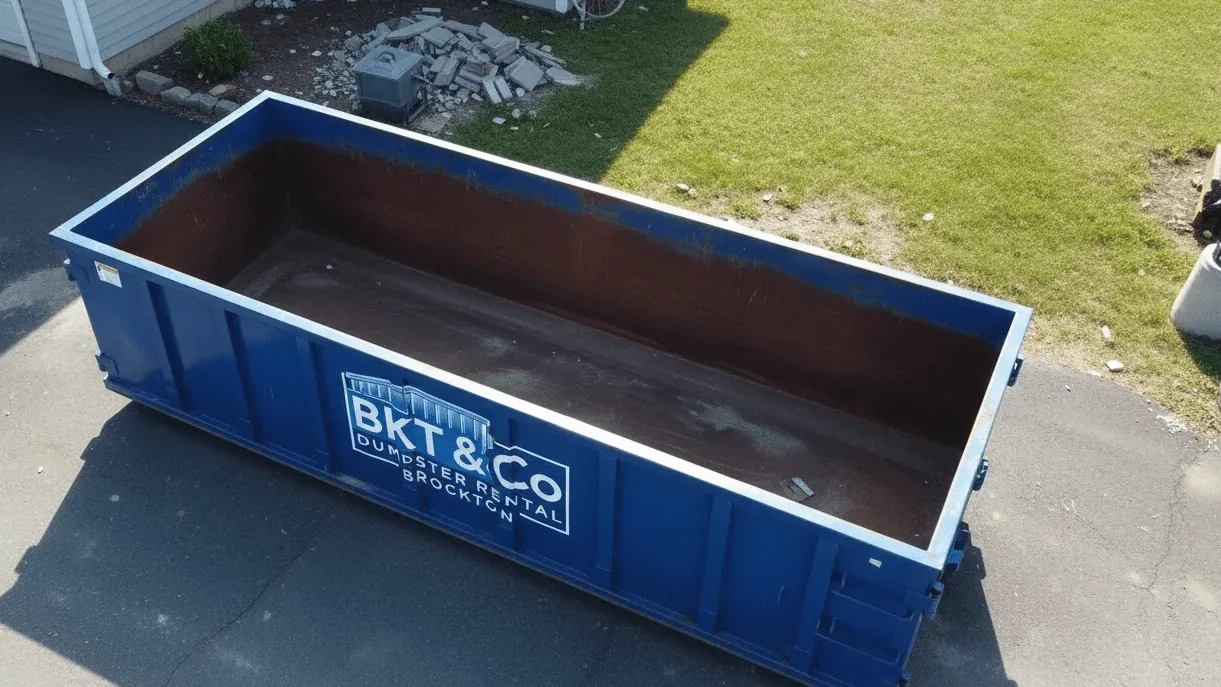
The other half of this service is material that is heavy without being masonry. Wet cellar contents from a full basement, old plaster and lath off a gut-out, and foundation spoil from a dig that had to reach 48 inches before anyone poured anything. All three are far heavier per cubic yard than they look, and all three catch people out the same way: a 10 yard is at payload long before it looks full. Load flat and low, spread across the floor rather than piled at the door end, and stop at the halfway line and call us if you are unsure. Our Brockton size guide works through it.
Heavy Material We Haul Here
Driveway And Walk Breakout
Broken concrete off a drive that has heaved through thirty winters. Clean ABC with a recycling route, so it goes in its own box rather than into a mixed load.
Front Steps And Patios
Masonry steps pulled away from the house and patio slabs that stopped draining. Small volume, heavy, and the classic job that fills a 10 yard to payload.
Foundation And Footing Spoil
Soil and stone out of a dig that had to reach 48 inches before a footing could be poured. Wet spoil is among the heaviest material we carry.
Chimney Brick
A stack taken down to the roofline or through the house. Brick is restricted from disposal and recyclable, so it stays clean and away from mortar-free timber.
Plaster And Lath
Off an interior gut in an older two-family. Dense, dusty and much heavier than the volume suggests, which is why plaster jobs go in a small box.
Wet Cellar Contents
Soaked cardboard, timber, carpet and stored contents out of a damp full basement. Water is the whole story here and it doubles the weight of everything.
Asphalt Pavement
Millings and slabs off a drive or an apron. On the disposal ban table since 2006 and genuinely recycled back into new mix, so it rides clean and separate.
Fieldstone And Rubble
Collapsed retaining walls, old fieldstone foundation sections and rubble from a porch pier. Dense, irregular and best loaded low across the container floor.
Sizing A Heavy Load
Heavy material is the one job where the smallest box is almost always the right answer. The 10 yard is the default for concrete, brick, asphalt, plaster, stone and foundation spoil, because all of them reach payload while the container still looks half empty from the street, and a box that is over payload cannot legally be hauled. A 15 yard makes sense where a moderate amount of masonry is going in with lighter demolition material, or where a damp cellar clear-out mixes soaked contents with ordinary junk. The 20 yard only belongs on a heavy job when the masonry is a small part of a much larger volume of light material. If you are between two sizes here, take the smaller one and let us swap it. A swap costs a day; an unhaulable container costs the schedule.
10 Yard Dumpster
Concrete, brick, plaster, foundation spoil and wet basement contents — weight fills it long before volume.
View this size →15yd³15 Yard Dumpster
A single room, a small tear-off, or one unit of a two-family turnover.
View this size →20yd³20 Yard Dumpster
A full basement and attic clear-out — the New England default — or a multi-room remodel.
View this size →Loading Flat, Low And Clean
How the box is loaded matters more here than on anything else we set. Spread the load flat across the floor rather than piling it at the door end, keep everything level with the top rail or below, and stop well short of the rail on masonry, because an overloaded box cannot be tarped and a load that cannot be tarped does not leave your property. Keep the ABC clean. Soil, timber, wallboard and general rubbish mixed through broken concrete take the load off the recycling route and back into the disposal stream, which is the outcome the 2006 ban exists to prevent. Placement is the other half. Protection boards go under the rails on every set and we photograph the surface first, but boards do not fix a drive that has already heaved, so we set across the sound section of an older slab. Spring is the difficult season: once the frost leaves the ground the verge and the unpaved side yard go soft, and a loaded heavy box will sink into ground that carried it in February. The fire code keeps the container 10 feet clear of combustible walls and openings, and Dig Safe on 811 goes in before any footing comes out.
Not sure this is the right service? Describe the job on the phone and we will point you at the right container even if it is a different service page. Call (508) 436-2303.
Get a flat quote
Two minutes on the phone gets you a size, a price and a delivery slot. No forms.
(508) 436-2303Recommended sizes
How it works
Concrete & Heavy Debris in four steps
- 1
Call us
Tell us the project, your address and when you want it. Two minutes on the phone and you have a flat price.
- 2
We deliver
Our driver walks the drop, lays protection boards and sets the container exactly where you want it.
- 3
You load it
Take your time within your rental window. Keep it level with the top rail and we handle the rest.
- 4
We haul it
Call or text when you are done. We pull it, sort what can be recovered and dispose of the rest properly.
Concrete & Heavy Debris FAQs
Why does concrete need its own container?
Because it has somewhere better to go. Asphalt pavement, brick and concrete have been off the Massachusetts disposal list since 1 July 2006 under 310 CMR 19.017, and behind that ban sits a real recycling industry: crushed concrete and brick become aggregate and road base, and reclaimed asphalt goes back into new mix. A clean load of ABC follows that route. The same material shovelled into a mixed demolition box does not, and it makes the rest of the load harder to place as well. Where a job genuinely cannot separate, a mixed roll-off is still legal in Massachusetts provided it goes to a permitted C&D processor, but keeping the masonry in its own box is the cleaner and simpler answer whenever the site allows it.
The job looks big. Why are you sending a 10 yard?
Because weight closes a heavy box out long before volume does. Concrete, brick, asphalt, stone, plaster, wet spoil and soaked cellar contents are dense enough that a 10 yard reaches its payload while it still looks half empty from the street. Putting that material in a 20 or a 30 does not get you more capacity, it gets you a container that cannot legally be lifted onto the truck, which means a wasted trip and a day lost on your schedule. If the load turns out lighter than expected we can swap in something larger. If you are partway through and unsure, stop at the halfway line and call us on (508) 436-2303 and we will look at photographs before anyone loads another wheelbarrow.
Can I mix some wood and wallboard in with the concrete?
Better not to. Two separate things happen if you do. The masonry loses its recycling route and becomes ordinary mixed debris, which is the outcome the 2006 ABC ban exists to prevent. And clean gypsum wallboard is itself a restricted material, off the list since 1 July 2011, which a receiving facility has to remove before transfer, so a mixed load carrying loose wallboard gets priced or refused accordingly. Keep three piles on a job like this: clean masonry, wallboard on its own, and everything else. That single instruction saves more trouble in Massachusetts than any other sorting rule we give people, and it costs nothing but a tarp on the ground.
The driveway is heaving and cracked. Is that just age?
It is mostly frost. Brockton records 137.5 nights a year at or below 32 degrees and 22.6 days where the temperature never gets above freezing, and the state building code puts the frost line at 48 inches, which is why footings and posts go down four feet here. Water gets into a joint or a hairline crack, freezes, expands and lifts the slab, then lets it back down slightly out of place, and thirty winters of that produces the heaved panels, stepped cracks and steps pulled away from the house that we break out every spring. Slabs poured shallow, on poor drainage or without proper base are the ones that go first. It is a different mechanism entirely from the shrink-swell soils people write about further south.
Where does the container go, and will it mark the drive?
Protection boards go under the rails on every set and we photograph the surface before steel touches it. Beyond that, three things decide placement on a heavy job. The condition of the slab comes first, because a drive that has already heaved has a sound section and a compromised one and we set across the sound part. Then the season: after the frost comes out in spring, verges, aprons and unpaved side yards go soft and a loaded masonry box will sink into ground that carried it easily in January. Then the fire code, which keeps the container at least 10 feet from combustible walls, openings and overhangs, 20 feet from an intersection and 10 feet from a hydrant. Send a photograph of the drive and the approach when you call.
More services
Other things we haul
Residential Dumpster Rental
Driveway placement for full-basement, attic, porch and shed cleanouts and remodels.
Learn more →Commercial Dumpster Rental
Containers for businesses and condominiums, which the City does not collect from at all.
Learn more →Construction Dumpster Rental
Jobsite roll-offs routed to a permitted C&D processor, with next-day swap-outs.
Learn more →Roofing Dumpster Rental
Weight-rated cans sized by squares and layers for asphalt shingle tear-offs.
Learn more →Roll-Off Dumpster Rental
10, 15, 20, 30 and 40 yard roll-offs across Brockton and the South Shore.
Learn more →Same-Day Dumpster Rental
Call before the cut-off and we can usually get a container to you this afternoon.
Learn more →Junk Removal Dumpsters
Clear a full basement, attic, porch or shed on your own schedule.
Learn more →Estate Cleanout Dumpsters
Discreet, patient container service for families clearing a lifelong home.
Learn more →Demolition Debris Removal
Containers and fast swaps for porches, decks, sheds, garages and interior gut-outs.
Learn more →Yard Waste & Brush Removal
Separate clean loads — Massachusetts has banned yard waste from disposal since 1992.
Learn more →Where we deliver
Concrete & Heavy Debris across Plymouth County and the South Shore
Same service, same flat rates, every town below. Pick yours for local placement and permit notes.
Talk to a real person
Need concrete & heavy debris in Brockton?
Tell us what you are clearing out and we will tell you the right size and the flat price to put it in your driveway. No forms, no waiting on an email — just call and we will sort it out in a couple of minutes.
Serving Brockton, Plymouth County and the South Shore · Mon–Fri 6:30am–5pm, Sat 7am–1pm