
Delivery
Driveway Protection on a Brockton Dumpster Delivery
Brockton driveways come apart from 137.5 freezing nights a year, not from summer heat. How we set a loaded roll-off on a narrow two-family lot without leaving a mark.
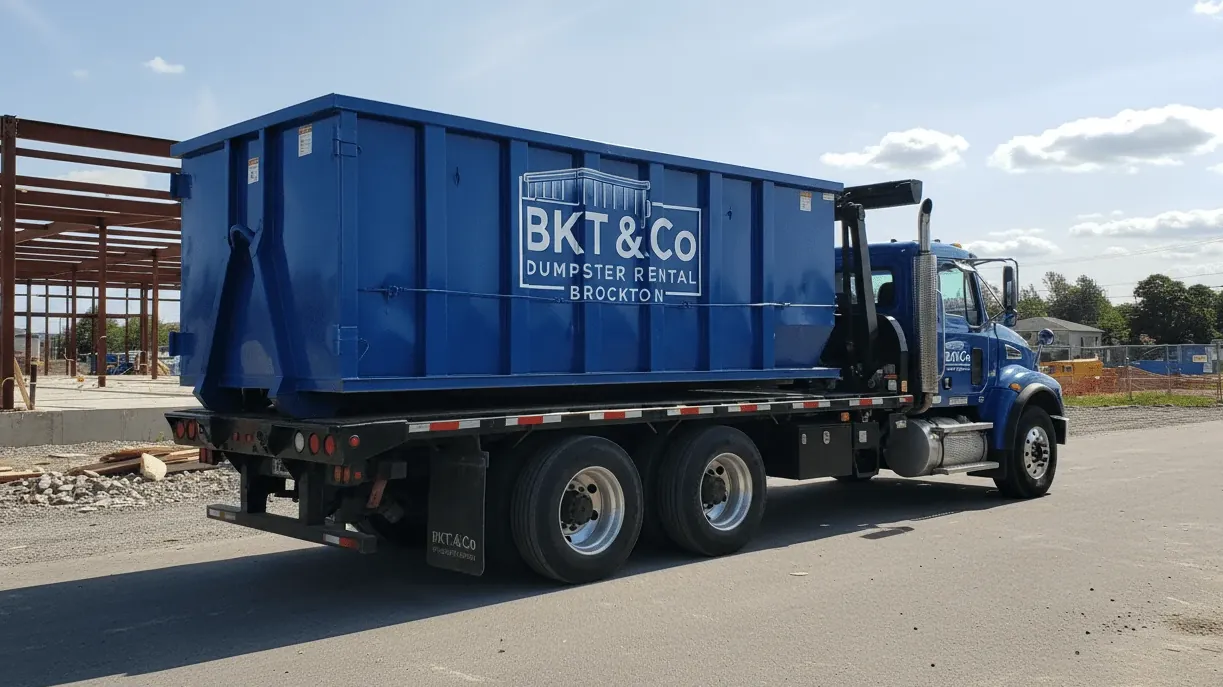
Nobody books a container thinking about their driveway. Then the truck backs in, the arm tips up, and several tons of steel rolls down onto the surface the family parks on every day. We have been setting roll-offs out of the yard at 1109 Montello Street since 2011, and placement is the part of this job we take slowest. Here the question is rarely whether the surface is strong enough, but whether thirty winters of frost have loosened what sits underneath it, and whether the arm can clear what hangs over it.
How a roll-off actually gets on the ground
A roll-off is placed with a cable hoist. The truck backs in, the arm tips up, the cable pays out, and the container runs down the rails at the back of the chassis on its own rear wheels until it is on the ground and the truck pulls out from under it. Nothing is lifted and set down gently: the box rolls off the back, and for a few seconds most of its weight rides on two small steel wheels.
Once down, a container does not rest on its floor. It sits on two steel rails running the length of the box, plus that pair of rear wheels, so the weight arrives through a handful of small contact patches rather than spreading across the footprint. That is point loading. A car spreads its weight over four soft tyres and never dwells; a loaded box is a static line load in one place for a week or two. An empty container is already several tons, and a 20 yard of plaster, tear-off or foundation spoil is a great deal more. The size guide has the footprints for the 10, 15, 20, 30 and 40.
And the truck is heavier than the box it carries. It covers the same ground twice, on delivery and again on the pull, so its wheel path across the apron matters as much as where the container lands.
What the truck needs
- About 60 feet of straight approach for truck and container together. Not 60 feet of driveway, but 60 feet of line the driver can back down without swinging the tail.
- About 10.5 feet of width for the truck and its mirrors.
- 20 feet or more of clear overhead while the hoist is working.
The overhead figure is the one people get wrong, always for the same reason: they measure the box. The box is not what stops the job. The arm is. A hoist at full tip reaches far above the roofline of the truck, so a limb or a service drop at fourteen feet is nothing to a car and an absolute stop for us. If the arm cannot come up, the container cannot come off.
Protection boards go down on every residential set
The answer to point loading is not complicated and it is not an upgrade. Boards ride on the truck and go under the rails and wheels on every residential set without you asking. They spread the load rather than letting it concentrate on a few contact points. On an old thin pour or a frost-lifted panel they get doubled.
The second thing on arrival is a photograph. The driver shoots the approach and the set spot before anything touches the ground, and again at the pull. Plenty of Brockton driveways already carry a hairline crack or a settled panel before our truck turns into the street, and with a picture from the moment we arrived, nobody argues later about a crack that was already there.
The New England driveway problem is freeze-thaw, not heat
This is where most national dumpster advice misleads you, because most of it is written for the South and the Southwest. There the worry is a hot surface going soft under a steel rail and keeping the print once it cools. That is not the problem here. Advice about waiting for a cooler part of the day was not written for a Brockton driveway.
Our problem is freeze-thaw. The NOAA 1991 to 2020 normals for the Brockton station record 137.5 nights a year at or below 32°F and 22.6 full freeze days when it never gets above freezing at all. Water gets into every joint and hairline crack, freezes, expands and levers it a fraction wider, well over a hundred times a year.
So asphalt that has been through thirty Brockton winters is already cracked, already lifted at the edges, and sitting on ground that has heaved and dropped many times over. That is not bad workmanship, it is what this climate does to flatwork, and our truck is not what started it.
Spring thaw is the genuine risk window
If there is one time of year to think hard about placement, it is the thaw. Frost coming out of the ground leaves the sub-base soft and saturated under a surface that looks solid from above, so a driveway that carried a loaded truck in October can rut or crack at a joint in late March. Lawns and gravel are worse. In spring we set on the firmest run we can reach, and if the ground is soft we would rather move the delivery a day than leave you with a repair.
Brockton lots are their own problem
Brockton was laid out in the shoe-factory era. Two-family houses went up by the thousand between 1870 and 1915, with three-deckers arriving after 1895 in Montello and down the Main Street corridor toward Campello. Those streets were built for carts and a streetcar, not for a roll-off truck. What the driver is assessing when he pulls up:
- The shared driveway. A narrow strip between two wood-frame two-families, often serving four households, sometimes with no turnaround. It is frequently under 10.5 feet at its pinch point, and that point is usually a corner board or a chimney base rather than the whole run.
- The bulkhead. Nearly every house here has one and it must not be blocked: it is egress from a full basement and a route in for a fire crew.
- The neighbour’s car. On a shared drive, one car left in place costs everybody the delivery. Have that conversation before we come, not while we sit in the street.
- Granite kerbing. Brockton has a great deal of it, and it is not a rolled concrete kerb. Cut granite at a narrow apron is unforgiving and dictates the angle the truck can take.
Look up before you decide anything
The overhead list is short and it stops more jobs than the ground does. First, utility service drops, the wires from pole to house, which on these older lots often cross the drive at exactly the height the arm needs. Second, mature maple and oak limbs, a century of canopy over a narrow drive. A limb that clears a van by a foot will not clear a hoist at full extension. Trimming beforehand settles it, and that wood is its own roll-off conversation, particularly after a storm has done the pruning, as our guide to nor’easter and storm damage cleanup covers.
Winter: snowbanks, windrows and wasted trips
From December to March the driveway is not the only variable. A plough windrow at the end of the drive is a dense berm a truck cannot push through, and a snowbank narrowing a shared drive from ten feet to eight makes the set impossible even though the surface underneath is fine. Piled snow also hides the kerb line, the apron edge and the bulkhead. So the request is plain: clear the drive and the set spot down to the surface before the truck comes, and clear enough width for the mirrors, not just for a car. If we cannot set, that is a wasted trip and a trip charge on a job with nothing wrong but packed snow.
A container standing in a Brockton street in January is also a plough obstruction, not only a fire code question. Ploughs run at night to a known street width, and a steel box that was not there last week is a hazard as well as a good way to have your container buried or struck. In deep winter, on-street placement is a last resort here.
The fire code decides placement more often than people expect
This surprises people who have rented containers in other states. Table 1.12.8.5 of 527 CMR 1.00, the Massachusetts Comprehensive Fire Safety Code, lists as a permitted activity “rubbish containers > 6 cubic yards”, issuing authority the head of the fire department. Every roll-off we run, the 10 through the 40, is larger than six cubic yards. The one exemption, at §1.12.8.5.1, is a container delivered and removed within a single business day. Section 1.12.8.5.2 also requires containers to be marked with the company name and an emergency telephone number, which ours are.
The clearances Massachusetts departments publish under NFPA 1 Chapter 19 are what move the box on a tight lot:
| Requirement | Distance | Why it bites in Brockton |
|---|---|---|
| From combustible walls, openings and overhangs | At least 10 feet | The binding constraint on most dense lots |
| From a street intersection | 20 feet | Rules out corner-lot kerb placement |
| From a fire hydrant | 10 feet | Common on older, closely hydranted streets |
| Top of container below any window | 5 feet, vertically and horizontally | Matters with a 30 or 40 alongside a house |
| Fire apparatus access, egress, fire escapes | Never blocked, never underneath | Shared drives and rear-yard sets |
Note the ten feet. The International Fire Code, used across most of the country, sets that clearance at 5 feet, and that is the number nearly all US dumpster content repeats. Massachusetts departments enforce 10 feet under NFPA 1. On a Brockton lot with a wood-frame two-family standing three feet off the property line and a drive ten feet wide in total, that ten feet from a combustible wall is very often the reason the box cannot go where the customer imagined. Sometimes there is no compliant spot on the drive at all.
Brockton’s published fire permit list does not itself advertise a container permit, but the state requirement applies regardless of what a city advertises. Ring Brockton Fire Prevention on 508-583-2933 and ask how they handle it for your address before you set a date. The permit is normally pulled by the property owner, lessee or refuse generator, not the hauler. More in our guide to dumpster permits in Brockton, and the code is published by the state at mass.gov.
If it has to go in the street
There is no published City of Brockton permit specifically for placing a container in the public way. The DPW’s published permits are the Street Opening Permit and the Public Works Construction License, which cover street openings and driveway cuts, not obstructions. We will not name a permit that does not exist. Ask DPW Engineering, 508-580-7139, dpw@brockton.gov about anything in the travelled way, and Fire Prevention about the container itself.
Condominiums: the driveway is usually not yours to lend
In a condominium the driveway and parking area are almost always common area held undivided under M.G.L. c.183A §5, so a unit owner cannot authorise a container on it, however reasonable the request. The trustees have to consent, and we ask every time, because a box set on common area without board approval becomes the unit owner’s problem inside a day. Note too: Brockton does not collect trash from condominiums or businesses at all, since city collection is limited to residents of one- to five-family homes who pay the trash fee. Associations here already contract privately. The statute is on malegislature.gov if a trustee wants to read it.
The pre-delivery checklist
- Measure the approach: roughly 60 feet of straight line, 10.5 feet of width at the pinch point, 20-plus feet of overhead.
- Move the cars the night before, and on a shared drive talk to whoever else parks there.
- Clear the snow down to the surface, windrow at the apron included.
- Mark the spot with a cone or a scrap of two-by-four and text us a photograph of it.
- Look up and tell us about the service drop and any limbs over the drive.
- Flag the bulkhead, and out in the towns the septic tank and leach field.
- Say what the surface is: asphalt, concrete, gravel or lawn. Four different conversations.
- Tell us the load type — roof tear-off, basement cleanout, kitchen gut, soil and stumps. That is how we bring the right box first time. Our sizing guide works it through, and if the window is tight, same-day delivery is often workable once the details are settled.
What we will not do
- Run a loaded truck across a soft spring lawn to save you a walk. The ruts outlast the rental by years, and the repair costs more than an extra twenty feet of carry.
- Set a box where the arm cannot clear a service drop. There is no careful version of that.
- Leave a container somewhere the fire department will make you move it. That is a second visit and an unhappy morning, and you would be paying for our mistake.
Tell us about the driveway before the truck rolls
BKT & Co has been running containers out of 1109 Montello Street, on Brockton’s north side a short run from Route 24, since 2011. Brendan Teixeira started with one truck and four cans and still answers the phone, which is why the detail is worth the call: the surface, the width at the tightest point, what hangs over the drive, where the bulkhead is, and whether the drive is shared. If the spot will not work, we would rather say so before the truck is loaded. Call (508) 436-2303 or get in touch.
Questions this guide did not answer? Call (508) 436-2303. We would rather spend two minutes on the phone than have you order the wrong container.