Roofing
Roofing Dumpster Rental in Brockton, Massachusetts
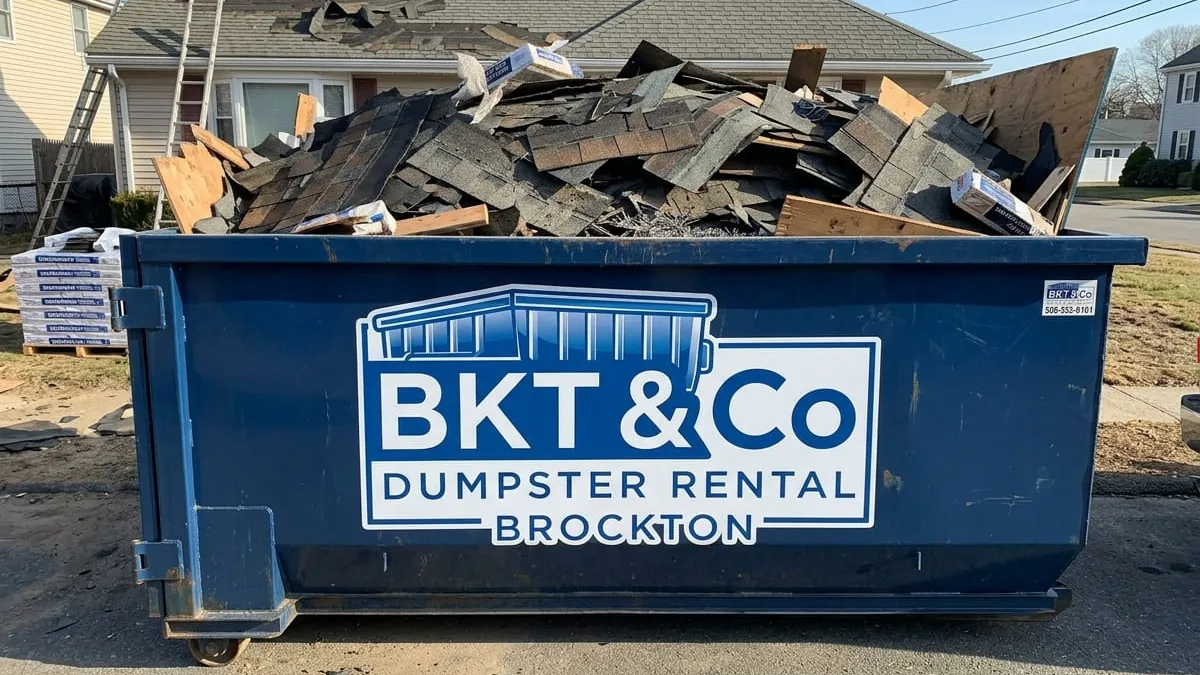
Weight-rated containers for asphalt tear-offs, sized by squares and layers rather than by the size of the house. Set close to the slide, boards under the rails, and the flashing pulled out as a separate stream.
Start by clearing up the thing half the internet gets wrong. Asphalt shingles are not banned from disposal in Massachusetts. The 310 CMR 19.017 table bans asphalt pavement, along with brick and concrete, and shingles do not appear on it anywhere. What is true is that there is a genuine recycling pathway — tear-off shingle is crushed into new asphalt mix or road base — which makes a clean single-stream tear-off one of the better candidates for source separation on any job site here. So the honest position is that shingle is disposable and also divertible, and the second is usually the better answer. Do not let anyone tell you the load is illegal, and do not assume it is worthless either.
A roofing container is a weight job rather than a volume job. Shingle is dense, it lands in a compact pile instead of filling the box, and a second layer roughly doubles what comes off the same roof area. That is why we size by squares and layers and ask about decking before picking a box, and why a container that looks half empty from the street can already be at payload. The New England detail on top of that is the ice barrier. Massachusetts answers yes to the ice-formation criterion in Table R301.2, so code section R905.1.2 requires an ice barrier under asphalt shingles, metal shingles, mineral-surfaced roll roofing, slate and wood shingles, extending at least 24 inches horizontally inside the exterior wall line and at least 36 inches from the eave edge on roofs of 8:12 or greater. Brockton also carries a 35 psf ground snow load, a 30 psf minimum flat-roof snow load and a 123 mph ultimate design wind speed, so the deck and the fastening schedule get looked at properly on a re-roof. Read the tear-off size guide before you order.
Two things come out of the load rather than into it. The first is metal. Ferrous and non-ferrous metal has been banned from disposal since 1 July 2006, so step and apron flashing, drip edge, valley metal, old aluminium gutter and any vent stack collar come off into their own pile. That is easy money and a compliance point at the same time. The second is the older material on this housing stock. Asphalt and asbestos-cement roofing and siding products are a real risk on pre-war Brockton houses, and the owner-occupied single-family carve-out in the state asbestos rules does not cover removal of more than 100 square feet of exterior cementitious shingles — a trap that catches people on siding and low-slope work in particular. If there is any doubt, a licensed inspector under 310 CMR 7.15 comes before the demolition bar. We cannot take asbestos-containing material in a container, ever.
Roofing Work We Set Containers For
Single-Layer Asphalt Tear-Off
The standard Brockton re-roof. Dense material in a compact pile, so we size by square count and set the box where the crew can slide straight into it rather than carry.
Two-Layer Tear-Off
A second layer roughly doubles the haul off the same roof area. This is where a container booked by cubic yards goes over payload and the job stalls on the drive.
Ice Barrier Retrofit At The Eaves
R905.1.2 wants ice barrier at least 24 inches inside the exterior wall line, and 36 inches from the eave on 8:12 or steeper. Old felt and drip edge come off with it.
Ice Dam Damage Repair
The February to April run of work: wet insulation, stained ceiling board, ruined trim and the section of deck that stayed damp all winter. Bulkier than the shingle.
Storm Repair And Partial Slopes
A wind-lifted slope or a limb strike after a nor'easter. Small volume, quick turn, usually a 10 yard on the drive for a day or two rather than a week.
Decking And Underlayment Replacement
Delaminated or rotten deck, felt and old drip edge coming off with the shingle. Bulkier per square than the shingle itself, so it moves the size answer up.
Flashing, Gutter And Vent Metal
Step and apron flashing, valley metal, drip edge and aluminium gutter. Metal is a banned material and comes out as its own stream rather than riding in the box.
Small Commercial And Low-Slope
Modified bitumen or built-up roof off a small commercial building. Heavy, heavier still after rain, and set in a rear service area at least ten feet off the wall.
Sizing A Tear-Off By Squares And Layers
Count the squares, count the layers, then call — that is the whole method, and it takes a minute. For a small roof, a single slope, or any tear-off where two layers are coming off together, the 10 yard is the safe answer, because shingle reaches payload while the box still looks empty from the street. Most single-layer re-roofs on an ordinary Brockton two-family sit in a 15 yard, which also has a better chance on a narrow shared drive in Montello or Campello. Take a 20 yard when decking is coming off with the shingle, when an ice barrier retrofit brings wet insulation and ceiling board down with it, or on a larger house with a wide apron. If it is close, we set the smaller box and swap it rather than leave one that cannot legally be hauled.
10 Yard Dumpster
Concrete, brick, plaster, foundation spoil and wet basement contents — weight fills it long before volume.
View this size →15yd³15 Yard Dumpster
A single room, a small tear-off, or one unit of a two-family turnover.
View this size →20yd³20 Yard Dumpster
A full basement and attic clear-out — the New England default — or a multi-room remodel.
View this size →Placement, Ice Dams And The Winter Board
Placement on a roofing job is about the slide rather than the parking. We set as close to the tear-off face as the drive allows so nobody carries material the length of a two-family, and boards go under the rails every time. The surface risk here is freeze-thaw: with 137.5 nights a year at or below freezing, water works into a joint in an apron, freezes and lifts it, so a drive with a stepped crack gets the load spread across its sound run. Overhead matters as much — maple, oak and white pine over these older streets, plus service drops across the front of the lot, and the hoist arm wants 20 feet of clear air. Then there is the calendar. Ice dam damage drives work from February into April, re-roofing peaks from June to September, and the weeks after a nor'easter compress the board hard because every roofer in the area is calling at once. Winter deliveries turn on snowbanks more than on temperature. Book early in those stretches, and see the storm cleanup guide for how the season runs.
Not sure this is the right service? Describe the job on the phone and we will point you at the right container even if it is a different service page. Call (508) 436-2303.
Get a flat quote
Two minutes on the phone gets you a size, a price and a delivery slot. No forms.
(508) 436-2303Recommended sizes
How it works
Roofing Dumpster Rental in four steps
- 1
Call us
Tell us the project, your address and when you want it. Two minutes on the phone and you have a flat price.
- 2
We deliver
Our driver walks the drop, lays protection boards and sets the container exactly where you want it.
- 3
You load it
Take your time within your rental window. Keep it level with the top rail and we handle the rest.
- 4
We haul it
Call or text when you are done. We pull it, sort what can be recovered and dispose of the rest properly.
Roofing Dumpster Rental FAQs
Are asphalt shingles banned from disposal in Massachusetts?
No. This gets stated wrongly constantly, so it is worth being precise. The disposal ban table at 310 CMR 19.017 lists asphalt pavement, brick and concrete as banned from 1 July 2006. Asphalt roofing shingles are not on the table at all, and never have been. What is true is that a recycling pathway exists — tear-off shingle gets crushed into new asphalt mix or road base — which makes a clean, single-stream shingle load a good candidate for diversion rather than disposal. Two things on the same roof genuinely are banned: ferrous and non-ferrous metal, which covers your flashing, drip edge and gutter, and asphalt pavement if you are also taking up a walkway. Tell us what the load actually contains and we will route it properly.
What size container do I need for a re-roof?
Give us the square count and the number of layers and we will size it on the phone. Shingle is dense and lands in a compact pile, so the box closes out on weight rather than volume, and a second layer roughly doubles the haul off the same roof area. Most single-layer Brockton re-roofs sit in a 15 yard; a two-layer job, or a small roof where the maths is tight, goes in a 10 yard we swap. Decking replacement pushes it the other way because rotten deck and felt are bulky for their weight, and an ice barrier retrofit that brings down wet insulation and ceiling board pushes it further. What we will not do is put a large box on a job whose material would take it past payload, because that container cannot be legally hauled and your crew loses a day.
Why is my roofer adding ice and water shield at the eaves?
Because the code requires it here. Massachusetts answers yes to the ice-formation criterion in 780 CMR Table R301.2, which brings section R905.1.2 into play: an ice barrier is required under asphalt shingles, metal shingles, mineral-surfaced roll roofing, slate and wood shingles, extending at least 24 inches horizontally inside the exterior wall line and at least 36 inches from the eave edge on roofs with a slope of 8:12 or greater. That is the direct code answer to ice dams, which form when heat escaping into the attic melts snow that then refreezes at the cold eave. The related work is attic air-sealing and insulation, and Mass Save runs a Pre-Weatherization Barrier Mitigation programme that pays toward removing asbestos or vermiculite and dealing with knob-and-tube wiring before insulating. Details are at Mass Save.
Our house has old cement shingles. Is that a problem?
It can be a significant one, and it is the trap on this housing stock. Older asphalt and asbestos-cement roofing and siding products are a genuine risk on pre-war Brockton houses. The carve-out that people rely on — owner-occupied single-family work — does not extend to removal of more than 100 square feet of exterior cementitious shingles, so a siding job or a wraparound low-slope section can cross the line without anyone intending it to. Under 310 CMR 7.15 a licensed asbestos inspector has to survey a facility containing suspect material before demolition or renovation, and the Department of Labor Standards licenses inspectors and contractors under 454 CMR 28.00. We cannot accept asbestos-containing material in any container under any circumstances. If the material is suspect, get it identified before the crew starts rather than after.
Can you get a container out the morning the crew starts?
Often, if you call early enough. We run from the yard at 1109 Montello Street on the north side of Brockton, a short run onto Route 24, so most of the city and the surrounding Plymouth, Norfolk and Bristol county towns are a quick trip. The constraint is the season rather than the distance. After a nor'easter the roofing board fills from the top down and same-day availability goes first, and in a hard winter the snowbank at the end of the drive decides more than the forecast does. Give us the date as soon as the job is booked and we will hold the slot. There is also a code angle worth knowing: a container delivered and removed within a single business day is exempt from the fire permit requirement, which is set out on our same-day page.
More services
Other things we haul
Residential Dumpster Rental
Driveway placement for full-basement, attic, porch and shed cleanouts and remodels.
Learn more →Commercial Dumpster Rental
Containers for businesses and condominiums, which the City does not collect from at all.
Learn more →Construction Dumpster Rental
Jobsite roll-offs routed to a permitted C&D processor, with next-day swap-outs.
Learn more →Roll-Off Dumpster Rental
10, 15, 20, 30 and 40 yard roll-offs across Brockton and the South Shore.
Learn more →Same-Day Dumpster Rental
Call before the cut-off and we can usually get a container to you this afternoon.
Learn more →Junk Removal Dumpsters
Clear a full basement, attic, porch or shed on your own schedule.
Learn more →Estate Cleanout Dumpsters
Discreet, patient container service for families clearing a lifelong home.
Learn more →Demolition Debris Removal
Containers and fast swaps for porches, decks, sheds, garages and interior gut-outs.
Learn more →Concrete & Heavy Debris
Dedicated heavy cans for concrete, brick, plaster and foundation spoil.
Learn more →Yard Waste & Brush Removal
Separate clean loads — Massachusetts has banned yard waste from disposal since 1992.
Learn more →Where we deliver
Roofing Dumpster Rental across Plymouth County and the South Shore
Same service, same flat rates, every town below. Pick yours for local placement and permit notes.
Talk to a real person
Need roofing dumpster rental in Brockton?
Tell us what you are clearing out and we will tell you the right size and the flat price to put it in your driveway. No forms, no waiting on an email — just call and we will sort it out in a couple of minutes.
Serving Brockton, Plymouth County and the South Shore · Mon–Fri 6:30am–5pm, Sat 7am–1pm