
Storm Cleanup
Nor'easter and Storm Damage Cleanup in Brockton: What to Do With the Debris
Brockton sees 137.5 nights a year at or below freezing and roughly 30 to 45 inches of snow in a normal winter. Here is what a nor'easter, an ice dam, a burst pipe or a tropical remnant leaves on a property here, how each pile loads, and which Massachusetts disposal bans catch storm work.
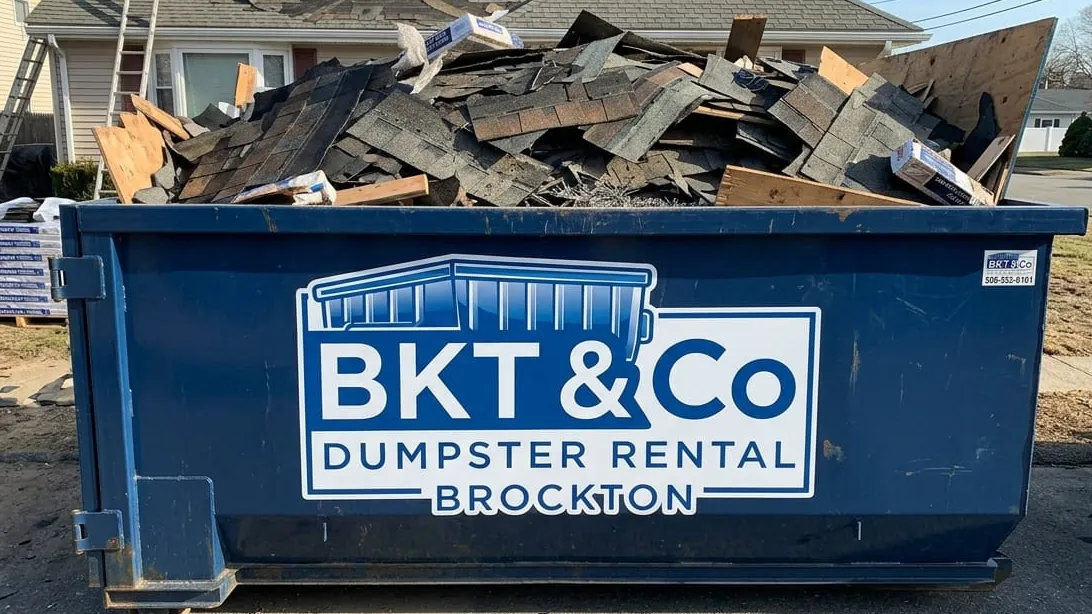
A nor'easter does not hit a house so much as lean on it. The wind comes out of the northeast for a day and a half, the snow loads the roof and stays there, ice builds along the eaves, and the real damage often shows up a week later — a stain spreading across a bedroom ceiling, a carport that folded overnight, a supply line that let go in a cold wall. This is a guide to what storm work in Brockton puts on the ground, how each pile loads, and which disposal rules stop you at the gate.
The shape of the season here
Brockton's storm calendar is a winter story with a rare and severe tropical footnote. The station numbers set the frame: 137.5 nights a year at or below 32°F and 22.6 full freeze days on which the temperature never climbs above freezing at all. That is more than four months of freezing nights, and it is why the work here is snow load, ice and burst pipe.
Snowfall is where you should be sceptical of any figure you read, including ours. The National Weather Service publishes no snowfall normal for the Brockton station. Boston Logan's normal is 43.8 inches a year and Taunton's is 28.0 inches, and Brockton sits between them. The only honest phrasing is roughly 30 to 45 inches in a normal winter, with enormous year-to-year variance.
For long-run scale, 45 billion-dollar disasters affected Massachusetts between 1980 and 2024: 15 winter storms, 15 severe storms, 9 tropical cyclones, 4 flooding events, 1 drought and 1 freeze. Winter and severe storms are tied at the top, and nine tropical cyclones in forty-five years is roughly one a decade.
The storms this region measures itself against
The Blizzard of '78
The region's cultural benchmark, referenced for what it established rather than for figures: a New England snow event can shut the region down for days, and the roof work it generates runs for months after the roads reopen.
28 to 29 January 2022
The best recent local yardstick, because it was measured close to home. Norton recorded 29 inches — the NWS office town, about twelve miles from Brockton — and Quincy recorded 30 inches. Boston tied its 24-hour snowfall record at 23.6 inches. Two feet of dense snow in a single event is what collapses carports, sheds and older flat porch roofs.
22 to 24 February 2026
The most recent big one, and only months old. NOAA described it as a historic bomb cyclone, with blizzard conditions and hurricane-force gusts from the Mid-Atlantic through New England. Providence recorded its largest snowstorm on record and Rhode Island set a new 24-hour state snowfall record of 37.9 inches.
Those are Rhode Island figures. No verified Brockton or Plymouth County total exists for that storm, so we are not going to attach one. Treat it as a regional event that put the whole seaboard under one system, which is why the equipment ran out for everybody at once.
Hurricane Bob, 19 August 1991
The last tropical system that genuinely knocked southeastern Massachusetts over, and within living memory here. Bob made landfall over Newport, Rhode Island just before 2pm, with gusts to 125 mph on Cape Cod. The line that matters inland: over 60 percent of the residents across southeast Rhode Island and southeast Massachusetts lost power. Trees into wires, and a week without electricity.
The Great New England Hurricane, 21 September 1938
The outer bound of what is possible here. Blue Hill Observatory in Milton, about thirteen miles north of Brockton, recorded sustained winds of 121 mph and a peak gust of 186 mph, and there were 564 deaths in Southern New England. Nearly ninety years back, but it is why the code takes wind seriously this far inland.
Hurricanes, honestly
Brockton is about 20 miles inland from Buzzards Bay. There is no storm surge risk here, and anybody selling you surge preparation for a Brockton address is selling you something else's problem.
What Brockton is, is a hurricane tree zone. Tropical systems come through roughly once a decade and the damage is overwhelmingly downed trees, torn shingles and week-long outages, on a canopy of mature maple, oak, white pine, birch and ash standing over driveways. The code agrees: 780 CMR 51.00, Table R301.2 assigns Brockton an ultimate design wind speed of 123 mph.
What each kind of storm puts in the container
Nor'easter and blizzard
Snow load is the mechanism. What comes off the property is snow-load roof damage, collapsed carports and sheds, torn shingles, bent gutters, and then the interior consequence a few days later: burst pipes and the drywall and insulation that has to come out behind them. Add limb wood from whatever broke under the weight. Two streams from one storm, and they have to be kept apart from the first hour.
Ice dam
The most under-estimated winter job in this housing stock. Water backs up under the shingle at the eave and finds the ceiling below. The debris is ceiling and wall drywall, soaked insulation and ruined flooring, followed by the fix, which is almost always attic work: air-sealing, insulation, and a re-roof with ice barrier.
In an older Brockton house that attic work often cannot start on schedule. Mass Save's Pre-Weatherization Barrier Mitigation programme exists because so much of this stock has asbestos or vermiculite in the attic or knob-and-tube wiring in the joist bays, and neither can be insulated over. It pays asbestos and vermiculite removal at $1 per square foot up to $4,000, knob-and-tube verification up to $2,000 and rewiring at $3 per square foot or 50 percent of cost — published utility figures, not ours. No asbestos-containing material goes in any box of ours, ever. Our basement and attic cleanout guide covers the sequence.
Tropical remnant
Wind and water, arriving in August or September. The pile is limb and trunk wood, fence sections, torn shingles, and then the contents of whatever basement took water while the power was out and the sump pump was not running. That last part is usually the larger volume, and it is a junk removal job more than a construction one.
Spring thaw
The quiet one. Frozen ground sheds meltwater rather than absorbing it, and it runs to the low point, which in a city of full basements is the basement. Out comes ruined stored contents, soaked cardboard, carpet and furniture. And the constraint that catches people out: the 48-inch frost line keeps the ground locked well into spring, so excavation stays off the table until it lets go.
| Event | What comes off the property | How it loads | Route |
|---|---|---|---|
| Nor'easter or blizzard | Roof damage, collapsed carports and sheds, shingles, gutters | Bulky and light, full of fasteners | Mixed structural load |
| Burst pipe | Drywall, wet insulation, flooring, trim, cabinets | Several times its dry weight | Interior load, sized for weight |
| Ice dam | Ceiling board, soaked insulation, ruined floor | Heavy once saturated | Interior load, then a roofing pull |
| Downed hardwood | Trunk sections, limb wood, brush | Will not compact | Clean wood load, on its own, by law |
| Basement water | Contents, cardboard, carpet, furniture, appliances | Banned items hide in it | Cleanout load, items pulled first |
The size comparison page shows what the 10, 15, 20, 30 and 40 yard boxes hold. On storm work the box runs smaller than people expect for wet material and larger for roof and yard debris, which is why we ask what is in the pile first.
The disposal rules that bite hardest after a storm
This is what separates a Massachusetts storm cleanup from the same job south of here. The state's disposal bans under 310 CMR 19.017 are the longest list in the country, and a storm produces banned material in a hurry. Our Massachusetts waste ban guide has the full table; these three catch storm jobs.
Limb wood rides alone
Leaves have been banned from disposal since 1991 and yard waste since 1992. Storm limb wood has to move as its own clean separate load — no shingle, no fence hardware, no wire mixed into it. A mixed container with a tree in it is not one we can lawfully deliver to a disposal facility, and the liability runs to the hauler alongside the generator. That is a yard waste load, ordered as such.
The kerbside route will not rescue you. Brockton's curbside yard waste collection is seasonal and does not begin until early July, so a March or April storm leaves a homeowner with no kerbside route at all. Even in season the limits are tight: branches under 4 inches in diameter, bundled, no more than 3 feet long and 35 pounds, and the City states plainly that yard waste in plastic bags or Brockton Pay Bags will NOT be picked up. Year-round drop-off is at the Recycle Depot, 300 Oak Hill Way.
Mattresses and textiles, and the contamination carve-out
Mattresses and textiles have been banned from disposal since 1 November 2022. A flooded finished basement produces both, usually within the first hour of clearing.
Here is the nuance most storm content misses: both bans exclude items contaminated with mold, bodily fluids, insects, oil or hazardous substances, and MassDEP publishes a Contaminated Mattress Certification Form for exactly this situation. A mattress genuinely ruined by flood water may qualify. That is not permission to throw one in the box on your own judgement. Ask the receiving facility first and document the answer — the form exists because the facility, not the homeowner, makes that call.
Everything else a flooded basement produces
Appliances, ferrous and non-ferrous metal, cardboard and paper, and cathode ray tubes and older televisions are all banned from disposal. A basement that took water produces every one of them: the washer and dryer, the freezer, boxes of paper turned to pulp, the old tube television nobody carried up the stairs. They come out of the load first and go to the Recycle Depot or a metal outlet. Pulling them at the start costs an hour; finding them at a failed load inspection costs a great deal more.
Roofing is the one place the rules are gentler than people assume. Asphalt shingles are not on the ban list — only asphalt pavement is — so a storm tear-off loads as a roofing container and goes to a permitted facility in the ordinary way; our tear-off size guide handles the weight arithmetic that decides the box. Interior tear-out runs as a demolition debris load, with clean gypsum wallboard kept separate.
Logistics in the week after a storm
Call early. After a region-wide event the board fills inside a week. That is arithmetic rather than a sales line: one storm damages tens of thousands of properties on the same night and every one of those households calls the next morning. On day five the honest answer is often a date rather than a truck.
A container in the street in winter is a plough obstruction. If more snow is forecast, the driveway is nearly always the better placement, and it keeps you clear of a conversation with the City about a blocked plough route.
The fire permit applies here, storm or no storm. Under 527 CMR 1.00, the Massachusetts Comprehensive Fire Safety Code, a rubbish container over 6 cubic yards is a permitted activity, issued by the head of the fire department. Every standard roll-off is larger than that, so a permit is required for essentially any container left overnight in Massachusetts, on private property or public. A same-day drop-and-go is exempt. Call Brockton Fire Prevention on 508-583-2933 to confirm how they handle it for your address.
And the placement figure most national dumpster content gets wrong: Massachusetts fire departments enforce at least 10 feet from combustible walls, openings and overhangs under NFPA 1, not the 5 feet written for other states. Containers must also carry the company name and an emergency telephone number.
The working order after a storm
Photograph the damage from four sides before you move a piece of it, and do not put anything in the container the insurance adjuster still needs to see — material that is already gone is hard to write into a claim, and after a region-wide event the adjuster may be a week or two out. Then sort: wood on its own, roofing on its own, banned items pulled out.
What helps on the phone: what the storm did, whether the material is wet, whether there is a tree in it, whether a basement took water, and how the driveway sits for a truck in snow.
BKT & Co Dumpster Rental Brockton has run roll-offs out of the yard at 1109 Montello Street since 2011. Brendan Teixeira started with one truck and four cans and still answers the phone, and on storm work he will size the box for weight rather than volume and tell you plainly what has to come out of the pile first. Call (508) 436-2303 or use our contact page.
Questions this guide did not answer? Call (508) 436-2303. We would rather spend two minutes on the phone than have you order the wrong container.