
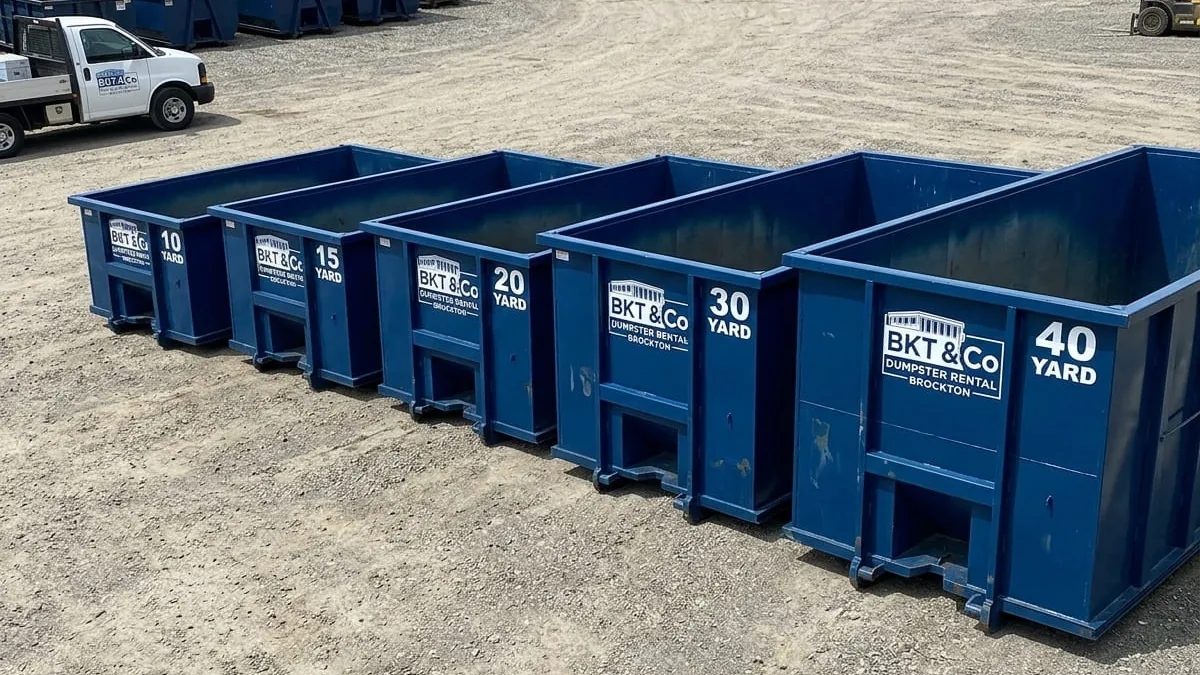
Compare all five sizes
Dumpster Sizes in Brockton, MA — 10, 15, 20, 30 & 40 Yard
Five roll-off sizes, and the honest version of which one you actually need. In Plymouth County two things decide it: what the debris weighs — broken concrete and brick, plaster, foundation spoil and wet basement contents all run heavier than they look — and whether the light material stays below the rails when a nor’easter comes through before we do.
All sizes
Pick by weight first, volume second
Scroll the table on mobile. If your load includes concrete, block, brick, roofing shingle, plaster, foundation spoil or fill, start at the 10 yard no matter how big the job looks — weight fills those long before volume does. Sizing calculators written for other parts of the country assume the whole house lives on one floor. Massachusetts sets a 48-inch frost line statewide, so footings have to reach four feet whatever is built on top, and once that hole is dug a full basement costs almost nothing extra — which is why New England pre-war housing is essentially all full-basement. Here the basement and the attic are the cleanout: storm windows, paint tins, a workbench, a chest freezer and thirty years of boxes come up the stairs and out the bulkhead. Drives are the constraint rather than volume, so measure before you order. The older streets off Main, Pleasant and Montello have narrow drives shared between two-families, and out on the rural edges toward Halifax, Hanson and Raynham the approach is often a long gravel or dirt lane with a maple, oak or white pine limb, a porch roof or the service drop that the hoist arm cannot swing under.
| Size | Capacity | Footprint | Weight allowance | Holds about | Best for |
|---|---|---|---|---|---|
| 10 Yard Dumpster | 10 yd³ | 12 ft x 8 ft x 3.5 ft | 2 – 3 tons | ~3 pickup truck loads | Concrete, brick, plaster, foundation spoil and wet basement contents — weight fills it long before volume. |
| 15 Yard Dumpster | 15 yd³ | 16 ft x 8 ft x 4 ft | 2 – 3 tons | ~4 – 5 pickup truck loads | A single room, a small tear-off, or one unit of a two-family turnover. |
| 20 Yard Dumpster | 20 yd³ | 22 ft x 8 ft x 4.5 ft | 3 – 4 tons | ~6 – 8 pickup truck loads | A full basement and attic clear-out — the New England default — or a multi-room remodel. |
| 30 Yard Dumpster | 30 yd³ | 22 ft x 8 ft x 6 ft | 4 – 5 tons | ~9 – 12 pickup truck loads | A whole two-family or three-decker with basement and attic, or a large remodel. |
| 40 Yard Dumpster | 40 yd³ | 22 ft x 8 ft x 8 ft | 5 – 6 tons | ~14 – 16 pickup truck loads | Bulky light debris only: porch framing, fencing, siding, insulation, fit-outs. |
10 Yard Dumpster
Concrete, brick, plaster, foundation spoil and wet basement contents — weight fills it long before volume.
View this size → 15yd³15 Yard Dumpster
A single room, a small tear-off, or one unit of a two-family turnover.
View this size → 20yd³20 Yard Dumpster
A full basement and attic clear-out — the New England default — or a multi-room remodel.
View this size → 30yd³30 Yard Dumpster
A whole two-family or three-decker with basement and attic, or a large remodel.
View this size → 40yd³40 Yard Dumpster
Bulky light debris only: porch framing, fencing, siding, insulation, fit-outs.
View this size →The two rules that decide it here
Weight beats volume on dense material, wind beats everything on light
This is the single most useful thing on the page. A container has two limits: how much volume it holds and how much weight a truck can legally lift and carry. Light debris runs you out of volume first. Dense material runs you out of weight first, and it happens far earlier than people expect.
Around Plymouth County the dense material is broken concrete, brick, plaster, foundation spoil and wet basement contents. Concrete and block run in the range of 2,400 to 2,800 lbs per cubic yard — a front walk, a patio slab, a section of foundation wall or an old cellar floor will reach legal transport weight in a can that still looks half empty. Footing and foundation spoil is the one people misjudge most: because footings go down four feet to clear the frost line, a small addition or a wall repair produces far more soil and rubble than the hole looks like it should, and through the spring thaw it comes out wet. Plaster and lath is the other quiet one — a gutted two-family throws a startling amount of weight into a box that still looks half full. Roofing is measured in squares and layers, never in roof area, and it is common here to find a second course still sitting on the deck, which doubles the tonnage on a roof that looked like a one-can job. A tear-off on a two-family off Belmont, Pleasant or Court Street that looks like a 20 yard job is often a weight job rather than a volume job, and it wants a 10 yard, sometimes twice. Worth knowing too: asphalt pavement, brick and concrete have been banned from disposal in Massachusetts since 2006 under 310 CMR 19.017, so that material is bound for a recycler either way and keeping it as its own clean load is the cheaper way to move it.
The second rule is the one out-of-state sizing charts never mention. Weather beats everything on light material. A 30 or 40 yard holding insulation, cardboard, housewrap and trim offcuts will redistribute itself down the street when a nor’easter comes through, and the wet is as expensive as the wind: Brockton takes 49.88 inches of precipitation in a normal year, plus roughly 30 to 45 inches of snow in a normal winter with enormous variance from one winter to the next. Rain and wet snow do not blow away — they soak into gypsum, carpet, cardboard and insulation, and you pay for that at the scale, which is the argument for covering a box you are filling slowly. Once anything stands proud of the top rail the load cannot be tarped or netted, which means it cannot legally be hauled either. So cap the load: heavy on the bottom, light on top, everything below the rails, and anything that can fly bagged or weighted before you walk away. Where the 40 earns its keep is bulk with no weight in it — a shed, porch or detached garage teardown, a whole-house cleanout, a basement full of panelling and storm windows — and the scrap metal and clean lumber are worth pulling out first, because metal is banned from disposal outright in Massachusetts and wood is banned from landfills, though a waste-to-energy plant may still take it.
Tell us the material and the rough quantity on the phone and we will size it properly. Getting it wrong costs us more than it costs you, so we have every reason to get it right.
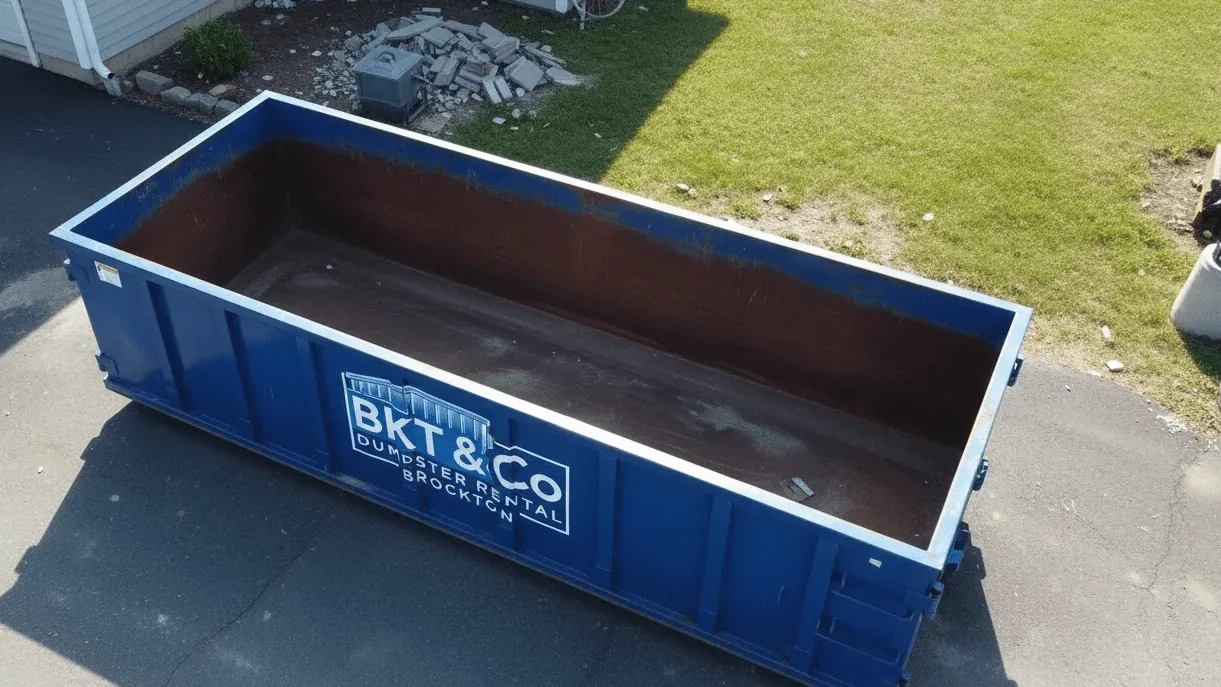
How it works
From phone call to empty driveway
- 1
Call us
Tell us the project, your address and when you want it. Two minutes on the phone and you have a flat price.
- 2
We deliver
Our driver walks the drop, lays protection boards and sets the container exactly where you want it.
- 3
You load it
Take your time within your rental window. Keep it level with the top rail and we handle the rest.
- 4
We haul it
Call or text when you are done. We pull it, sort what can be recovered and dispose of the rest properly.
Choosing a Size — FAQs
Which dumpster size is most popular in Brockton?
The 20 yard, by a wide margin. It handles a kitchen gut, a multi-room remodel, or a full basement and attic emptied in one go on a two-family, and it still sits on a normal Brockton driveway. The 15 yard is next most common because it is the sweet spot for a single room, a tenant turnover or a shingle tear-off on an average house. Anything with concrete, brick, plaster or foundation spoil in it goes the other way, down to a 10 yard.
What size do I need for a roof tear-off?
For a Brockton house on asphalt or dimensional shingle, a 15 or 20 yard. Roofing is weight-driven rather than volume-driven, so squares and layers decide it, not roof area — and it is common to find a second course still sitting on the deck, which doubles the tonnage. What fills the roofing calendar here is ice. Massachusetts answers yes to the ice-formation criterion in the building code, so an ice barrier is required under a new shingle roof, and the same winters that drive ice dams drive the ceiling and insulation tear-out underneath. Asphalt shingles are not on the Massachusetts disposal ban list — only asphalt pavement is — but they are still worth keeping as their own load, because there is a recycling route for them. Remember that the City of Brockton collects no construction debris at the kerb at any volume, roofing included; that is on the contractor or on you. Pre-1980 roofing felt, mastic and cement-asbestos shingle can contain asbestos, which stops the job until it is tested: the pre-demolition survey and abatement side sits with MassDEP under 310 CMR 7.15, the demolition dust notification is 310 CMR 7.09, form AQ 06 — ten working days ahead, exempt under 20 dwelling units, $100, and contractors are licensed by the Department of Labor Standards under 454 CMR 28.00. Our tear-off sizing guide has the full maths.
Is the 40 yard just the biggest and best?
No, and treating it that way is an expensive mistake. The 40 yard is a volume container for bulky light debris — framing, cabinetry, porch lumber, packaging and whole-house cleanouts. Put anything dense in it and you will exceed legal transport weight long before it is full. It is also the size a nor’easter punishes hardest: a big open box of light material has to be loaded below the rails and covered, or it empties itself down the street and soaks up its own weight in rain. And it needs the most approach room and overhead clearance, which rules it out on the shared drives around Montello and Campello and the older streets off Main and Pleasant, and on long gravel or dirt lanes out toward Halifax and Hanson.
Can I change size after I book?
Yes, as long as the truck has not been dispatched. If you describe the job and we think you have ordered wrong, we will say so before delivery rather than after. Changing on the phone costs nothing; discovering it at the scale house costs a great deal.
How much space do I need?
Roughly the container footprint plus working room: about 60 feet of straight approach for the truck, around 10 and a half feet of width, and 20 feet or more of overhead clearance while the hoist operates. There is also a setback rule most national guides get wrong. Massachusetts fire departments enforce 10 feet from combustible walls, openings and overhangs under NFPA 1, not the 5 feet the International Fire Code uses elsewhere, plus 20 feet back from an intersection, 10 feet from a hydrant, and the top of the box at least 5 feet below any window. On a tight two-family lot that is the real constraint, not the driveway. Look up before you decide — a maple, oak or white pine limb, a porch roof, a low gutter or the service drop into the house will stop the arm cold. Summer here is mild, with average highs of 82.1°F in July and 80.6°F in August, so the season that dictates placement is winter: with 137.5 nights a year at or below freezing and 22.6 days that never get above it, snowbanks and the plough windrow decide whether a drive that took a 30 in October still takes one in February. Tell us what the approach looks like and we will bring the right box.
Services
What people put in them
Residential Dumpster Rental
Driveway placement for full-basement, attic, porch and shed cleanouts and remodels.
Learn more →Commercial Dumpster Rental
Containers for businesses and condominiums, which the City does not collect from at all.
Learn more →Construction Dumpster Rental
Jobsite roll-offs routed to a permitted C&D processor, with next-day swap-outs.
Learn more →Roofing Dumpster Rental
Weight-rated cans sized by squares and layers for asphalt shingle tear-offs.
Learn more →Roll-Off Dumpster Rental
10, 15, 20, 30 and 40 yard roll-offs across Brockton and the South Shore.
Learn more →Same-Day Dumpster Rental
Call before the cut-off and we can usually get a container to you this afternoon.
Learn more →Talk to a real person
Not sure which size you need?
Tell us what you are clearing out and we will tell you the right size and the flat price to put it in your driveway. No forms, no waiting on an email — just call and we will sort it out in a couple of minutes.
Serving Brockton, Plymouth County and the South Shore · Mon–Fri 6:30am–5pm, Sat 7am–1pm