
Roofing
Roofing Tear-Off Dumpster Size Guide for Brockton
A shingle tear-off is a weight job, and in Massachusetts it is a code job too. Size it by squares and layers, plan for the ice barrier section R905.1.2 requires, and keep metal, cardboard and wallboard out of the load.
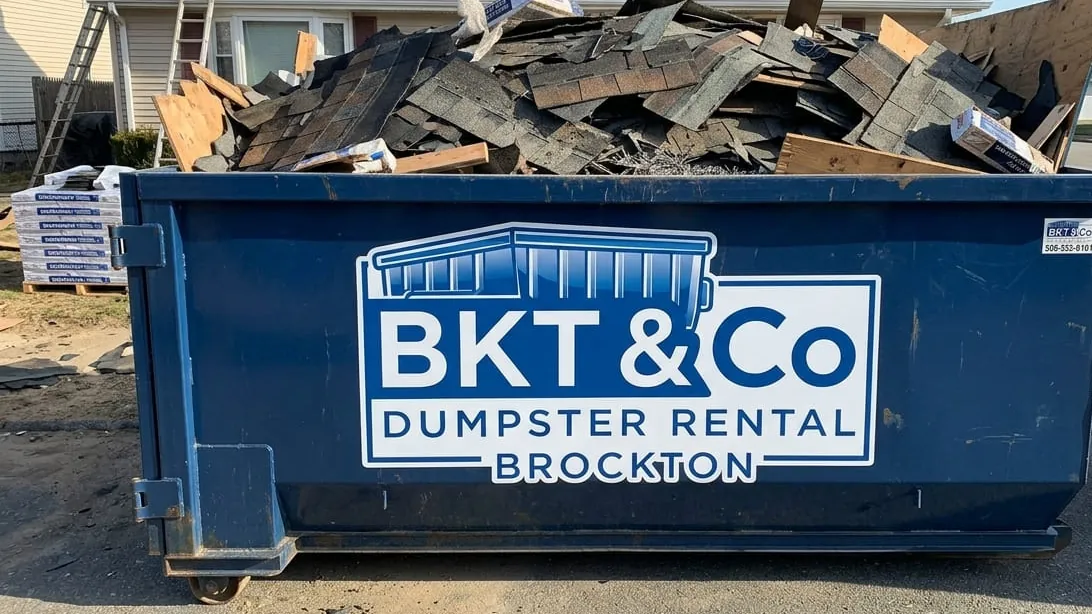
Roofing is the one job where the floor area of the house tells us nothing useful. What we need is the roof in squares and the number of layers already up there, because a tear-off is a weight job: volume runs out slowly and weight runs out fast, and weight decides whether the truck can lift the box back off a Brockton driveway. And a Massachusetts re-roof is a code job with an ice-and-water shield requirement, not just a shingle swap.
The Massachusetts driver is ice, not hail
Most roofing content written for the rest of the country is built around hail claims. That is not the story here. Massachusetts answers YES to the ice-formation criterion in Table R301.2 of the residential code, and because it does, code section R905.1.2 requires an ice barrier under asphalt shingles, metal shingles, mineral-surfaced roll roofing, slate and slate-type shingles, and wood shingles and wood shakes. It has to extend at least 24 inches horizontally inside the exterior wall line, and at least 36 inches from the eave edge on roofs of 8:12 slope or greater.
That line changes the job: membrane goes down at the eaves whether the old roof had any or not. Brockton's other design numbers come out of the same table: ground snow load 35 psf, minimum flat-roof snow load 30 psf, ultimate design wind speed 123 mph.
The neighbours sit a mile an hour either side. Whitman and West Bridgewater are 124 mph; Randolph and Stoughton are 122. Nobody a few towns over gets an easier roof. The code tables are published through mass.gov.
Ice dams, and the work they generate
Brockton records 137.5 nights a year at or below 32°F, and that number is behind every ice dam in the city. Heat leaks into the attic, snow melts on the warm part of the deck, and the water runs down to the cold overhang past the heated envelope and freezes. The ridge of ice holds the next melt behind it, and shingles lapped to shed running water do not hold standing water. It goes back under the courses and comes through at the top plate.
So a Brockton roofing job often turns into three: the roof gets the ice-and-water shield the code calls for, the attic gets air-sealed and insulated so the deck stops melting snow from underneath, and the wet ceiling and ruined batts become their own load.
The attic half has a funded route. Mass Save's Pre-Weatherization Barrier Mitigation exists because insulation crews keep opening attics and finding something that must come out first:
- Asbestos or vermiculite removal — $1 per square foot, up to $4,000.
- Knob-and-tube verification — up to $2,000.
- Knob-and-tube rewiring — $3 per square foot, or 50 percent of the cost, for buildings under 8,000 square feet.
Knob-and-tube is common enough here that a statewide utility programme pays to pull it out, and on a two-family built between 1870 and 1915 it is worth checking before the insulation crew arrives. Detail is at masssave.com.
Squares, layers, and what fills the box
A square is 100 square feet of roof surface, not floor area. Pitch, hips, valleys, dormers and overhang all add surface, so a two-family with a steep gable and a couple of dormers carries far more roof than the assessor's card suggests. Take the square count off the roofer's proposal.
A single layer of three-tab asphalt runs roughly 250 lb per square; architectural laminate 300 to 400. Add 5 to 10 percent for felt, membrane, drip edge, ridge, boots and nails, more again if deck boards are coming off.
Then the part that changes the container. A second layer roughly doubles the tear-off weight and a third roughly triples it, on the same roof, with the same footprint. Nothing looks different from the street, but a three-layer tear-off on an older two-family is a completely different job from a single layer, and the box runs out of weight at half the volume. Count the courses in the cut edge at a rake or an eave, or ask the crew on the first morning — the container can be changed then, not once it is full.
The sizing table
Weights are shingle plus underlayment and fasteners, rounded, for a standard laminate. Staged means one box in the drive with a swap booked in advance, not a bigger box.
| Roof size | Layers | Approximate weight | Container that works | Notes |
|---|---|---|---|---|
| 12 squares | 1 | ~1.6 tons | 10 yard | Garage, addition or repair. |
| 15 squares | 2 | ~4 tons | 15 yard | Ordinary on an older cottage. |
| 20 squares | 1 | ~2.6 tons | 15 yard | One pull, room to spare. |
| 20 squares | 2 | ~5.2 tons | 20 yard | The row people underestimate. |
| 20 squares | 3 | ~7.8 tons | 20 yard, staged | Two pulls. Do not force it into one. |
| 30 squares | 3 | ~11.5 tons | Staged, two to three pulls | A scheduling job. Call first. |
| Deck boards off | Any | Add the boards | One more pull | Bulky rather than heavy. |
Dimensions are on the dumpster sizes page, and there is a general walk-through in what size dumpster you need in Brockton. The three doing nearly all the roofing work here are the 10 yard, 15 yard and 20 yard. The rule underneath the table fits in one line: you size a roofing can by weight, not by how full it looks. A 20 yard with three feet of shingle in it can already be at the limit.
Shingles are not banned in Massachusetts
You will read on plenty of sites that asphalt shingles are banned from disposal here. They are not. The waste ban table at 310 CMR 19.017 lists asphalt pavement, with brick and concrete, banned from 1 July 2006. Shingles are not on the table anywhere.
What is true is that there is a real recycling pathway. Shingles are crushed into new asphalt mix or used as road base, and RecyclingWorks Massachusetts identifies shingles as a good candidate for job-site source separation — a roofing-only container, kept clean, costs less to handle than the same shingle mixed through a demolition load. That is a commercial argument, not a legal one, and reason enough to keep the roof load to itself. See recyclingworksma.com.
What cannot ride along
What gets a roofing load rejected is almost never the shingle. It is what comes off with it.
- Metal flashing, drip edge, valley metal and old gutter. Ferrous and non-ferrous metal have been banned from disposal since 1 July 2006 and go for scrap. Pull them into their own pile on the ground.
- Cardboard. Banned since 31 December 1994, and a shingle job produces a surprising volume of bundle wrap and carton.
- Clean gypsum wallboard, if the job runs inside after an ice-dam leak. Banned since 1 July 2011, and it has to be removed before a mixed load is transferred. Keep ceiling board in its own pile.
We ask what is going in the box before we quote because the bans apply to the generator and the hauler alike, and we are on the hook next to you.
The asbestos trap on an old roof or siding
This is the one that stops a job. Older asphalt/asbestos-cement roofing and siding products can contain asbestos — the rigid, brittle shingle that snaps rather than tears, on the roof or on the wall under later vinyl.
The rule people get wrong: 310 CMR 7.15's owner-occupied single-family carve-out does not cover removal of more than 100 square feet of exterior cementitious shingles. Owning and living in the house does not exempt a siding strip, and 100 square feet is one wall of a two-family. A licensed inspector must survey any facility with suspect material before demolition or renovation, and the Department of Labor Standards licenses that work under 454 CMR 28.00.
We cannot take asbestos-containing material in any container, on any job. Test before anyone touches it. A positive result goes to a licensed abatement contractor, not into one of our boxes.
Placement on a Brockton lot
A re-roof is a crew shovelling from height, so debris lands where gravity puts it. Set the box where the pitch drops, not where it looks tidiest. Every ten feet the crew carries shingle by hand is tons moved needlessly.
- Protection boards go under the rails on every set, standard on a roofing job, because a loaded can is a concentrated load on ground that freezes and thaws all winter.
- Approach: roughly 60 feet of straight run to set down and hook back up, and about 10.5 feet of width past gates, fences and parked cars.
- Overhead: 20 feet or more of clear vertical space. Mature maple and oak over a drive is the usual obstruction; a wire drop to a second-floor service is next.
- The tight driveway between two two-families in Montello or Campello is the standard Brockton problem. Houses of that era sit close together on narrow lots and 10.5 feet is not always there; when it is not, the box goes at the head of the drive or at the kerb.
- Tarps and magnets: tarp the planting under the eave, and magnet the drive and lawn at the end.
Then the fire code, which is not what out-of-state guides describe. 527 CMR 1.00, Table 1.12.8.5 lists rubbish containers over 6 cubic yards as a permitted activity, issued by the head of the fire department. Every roll-off is bigger than that, so a container left overnight needs a fire chief permit, on private property as much as on the street. Delivered and removed inside one business day, it is exempt.
- At least 10 feet from combustible walls, openings and overhangs — not the 5 feet the International Fire Code uses elsewhere.
- Not within 20 feet of an intersection.
- Not within 10 feet of a fire hydrant.
- The top of the box at least 5 feet below any window.
On a dense city lot beside a wood-frame two-family, that 10-foot rule genuinely decides where the box goes. It rules out the spot tight against the clapboard that everyone suggests first. Call Brockton Fire Prevention on 508-583-2933 to confirm how they handle it for your address, and read dumpster permits in Brockton before you book.
Season: June to September, and the tail end
Roofing here runs June through September, and the working conditions are the quiet advantage of this market. The July average high is 82.1°F and August is 80.6°F. Crews are not driven off the deck by heat at midday the way they are in the southern markets, so a tear-off runs as full days rather than short mornings.
The tail end is where planning matters. Once nights turn cold, asphalt does not seal properly, and a shingle that has not sealed is one the first nor'easter lifts. Get it closed in before frost and before the storm season. A size can be changed with a call the day before delivery; a slot on the truck in October cannot.
Storms, honestly
Brockton is not a hurricane coast. It sits about 20 miles inland from Buzzards Bay, with no storm surge. It is a hurricane tree zone: when a tropical system comes through, the damage is downed trees, torn shingle and week-long outages.
The last one that genuinely knocked this region over was Hurricane Bob, on 19 August 1991, which left over 60 percent of residents across southeastern Massachusetts and southeastern Rhode Island without power. But nor'easters and blizzards are the far more frequent driver of roof work here: wind-lifted shingle, ice-dam leaks and February limb strikes do more cumulative damage. The clean-up side is covered in nor'easter and storm damage cleanup in Brockton.
Which box, and what to tell us
For a single-layer roof under about 25 squares, the 15 yard is usually right. For two layers, or anything over 25 squares, the 20 yard is the working box. Three layers on a large two-family is a staged job. The 10 yard is not a compromise — it is right for a garage, an addition or a single-slope repair, and it fits a drive nothing else will.
Keep the load to the roof. Shingle, felt, membrane, boots, ridge vent and nails ride together; metal goes to scrap, cardboard comes out, ceiling board is its own pile. Mixed renovation debris runs better on a construction dumpster rental, and roofing detail is on our roofing dumpster rental page.
Four things and we can size it on the phone: the square count, the number of layers, whether the deck boards are coming off, and what the driveway approach looks like. BKT & Co has run roll-offs out of the yard on Montello Street since 2011, and Brendan Teixeira still answers the phone. Call (508) 436-2303 or use our contact page, and have the squares and layers ready before he asks.
Questions this guide did not answer? Call (508) 436-2303. We would rather spend two minutes on the phone than have you order the wrong container.