Permits
Dumpster Permits in Brockton, MA: The Fire Code Rule Nobody Mentions
Massachusetts requires a fire department permit for essentially every roll-off left overnight, and most people have never heard of it. What 527 CMR 1.00 Table 1.12.8.5 actually says, the single-business-day exemption, why the setback here is ten feet and not five, and the Brockton numbers to call before you book a delivery.
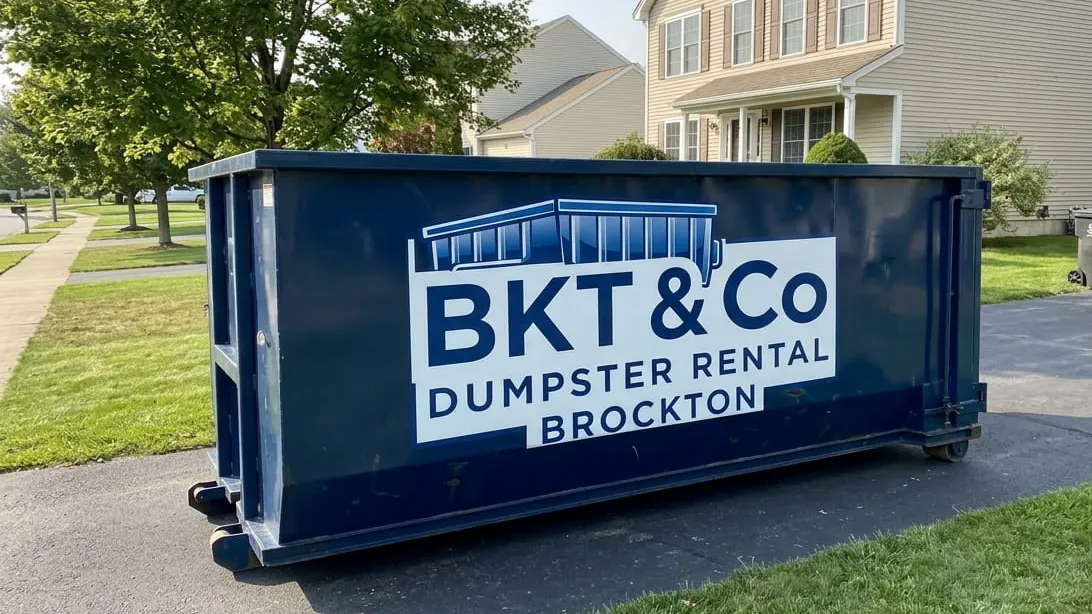
The permit question arrives right after the size question, and in Massachusetts the honest answer catches nearly everyone out. Almost all of the dumpster-permit advice online was written for states working under the International Fire Code. Massachusetts writes its own fire code, that code names rubbish containers directly, and the threshold it uses is smaller than every roll-off we own.
The rule almost nobody mentions: 527 CMR 1.00
527 CMR 1.00 is the Massachusetts Comprehensive Fire Safety Code. It carries a master list of permitted activities at Table 1.12.8.5, and one line reads, in the code's own shorthand:
"Rubbish containers > 6 cubic yards" — issuing authority, Head of the Fire Department — code section 19.1.1.
Six cubic yards. Our smallest container is a 10 yard, and the rest of the fleet runs 15, 20, 30 and 40 yard. Every one is over the threshold, and it is not close — a 10 yard box is nearly twice the size of the trigger. So Table 1.12.8.5 reaches essentially every roll-off in the Commonwealth, private property or public. It is a statewide code administered by each local fire chief, so Brockton, Avon, Stoughton and East Bridgewater all face the same requirement from a different desk.
The exemption that decides most jobs: one business day
There is a carve-out, and it is the most useful sentence in the section. §1.12.8.5.1: "A permit shall not be required for containers which are delivered to a location and removed in the course of a single business day."
The line falls exactly there. A container dropped in the morning, loaded during the day and hauled away that afternoon is exempt on its face. One left on the ground overnight is not. That is the whole test — not the size of the job, not residential versus commercial, not whether it sits on your own driveway. For a garage clearout the exemption is reachable. For a roof, a full-basement cleanout in a Montello two-family, or any construction dumpster rental across a work week, it is not.
§1.12.8.5.2: the container has to be marked
The second subsection is short and it is a real obligation. "Containers shall be marked with the name and telephone number of the company who can be reached in an emergency." The reason is obvious once you have seen a container fire at two in the morning: the officer on scene needs to know who owns the box and who can move it, legible from the street.
Ten feet, not five — and this is where most articles are wrong
This is the correction that matters most on the page. Most US dumpster content quotes a five-foot separation between a container and a building. That figure comes from the International Fire Code, which most states have adopted. Massachusetts has not. 527 CMR 1.00 adopts NFPA 1, 2021 edition with Massachusetts amendments, and the substance sits in NFPA 1 Chapter 19, "Combustible Waste and Refuse." The code took effect 9 December 2022, amendments 12 May 2023, enforced through the Department of Fire Services and your local fire chief. Under that chapter, Massachusetts fire prevention bureaus publish placement conditions on their container permits. Lawrence and Falmouth publish much the same set, and the separation figure in both is ten feet:
- At least 10 feet from combustible walls, openings or combustible overhangs.
- Not within 20 feet of an intersection.
- Not within 10 feet of a fire hydrant.
- Adjacent to a building, the top of the container must sit at least 5 feet below any window, vertically and horizontally.
- It must not obstruct vehicular or fire-apparatus access, block egress, or sit under a fire escape.
- It must display the company name and an emergency telephone number, and be emptied when full.
- No flammable or combustible liquids — that includes half-full paint cans and the gas can from the mower.
On a Brockton lot, ten feet is a far harder number than five. The typical two-family sits narrow, with the driveway down one side and a wood-clad wall as the only thing to measure from, which is why we ask about driveway width before delivery rather than on the day.
Two more items from those permits matter. Falmouth publishes a fee of $25.00 for its container permit — Falmouth's own figure, quoted only to show these permits are real and routine where they are administered. And the permit is pulled by the property owner, lessee or refuse generator, not necessarily the hauler. That catches general contractors, who assume whoever delivers the box handles the paperwork.
How Brockton handles it
Brockton Fire Department Fire Prevention is on 508-583-2933, Office of the Fire Chief, 560 West Street. The city's published permit list covers Oil Burner, FP-6, the FP-292 Tank Removal permit, Outdoor Burning and Fire Detail. A container permit is not on that list, and no fee for one appears on the published schedule.
That does not make the state requirement go away. 527 CMR 1.00 applies in every Massachusetts city and town regardless of what an individual department advertises, so in practice the handling here is a phone call rather than a form download. Call Brockton Fire Prevention on 508-583-2933 to confirm how they handle it for your address. We will not publish a Brockton container-permit fee or a Brockton ordinance number, because neither appears in anything the city publishes.
Private driveway or the public way
On your own driveway or parking area, no separate municipal permit has been identified in Brockton. What you need is the owner's consent, a surface that will take the weight, and placement satisfying the fire-code conditions above. The overnight question still applies: a container over six cubic yards left overnight on private property is squarely inside Table 1.12.8.5. Private ground is not the exemption — the single business day is. Our notes on driveway protection at delivery cover the surface.
For the public way, be careful what you go looking for. There is no published City of Brockton permit specifically for placing a container in the street. The DPW publishes a Street Opening Permit and a Public Works Construction License, and both address street openings, excavation and driveway cuts — not temporary obstructions. Neither is a dumpster permit.
If the street is the only option — a downtown three-decker with no off-street parking, a Campello block where the driveway is the only access — ask directly. DPW Engineering is on 508-580-7139, or dpw@brockton.gov. Give them the address, the container size and the dates.
Who to call for what
| Situation | Authority | Contact or note |
|---|---|---|
| Container over 6 cubic yards left overnight | Head of the Fire Department, 527 CMR 1.00 Table 1.12.8.5 | Brockton Fire Prevention · 508-583-2933 · 560 West Street |
| Placement in the public way | No published Brockton container permit — ask first | DPW Engineering · 508-580-7139 · dpw@brockton.gov |
| Condominium common area | The trustees, under M.G.L. c.183A | Written consent before the delivery date |
| Heating oil tank removal | Brockton Fire, FP-292 Tank Removal Permit | 508-583-2933 · fees below |
| Demolition or renovation | Brockton Building Department, plus MassDEP | 508-580-7150 · 45 School Street |
| Any digging | Dig Safe System, Inc., M.G.L. c.82 §40 | 811 or 888-344-7233 |
Condominiums: the Brockton trap nobody warns you about
Under M.G.L. c.183A §5, each unit owner in a Massachusetts condominium holds an undivided interest in the common areas, and in practice the driveway, parking area and lawn are almost always common area rather than part of anyone's unit. A unit owner cannot unilaterally authorise a container to sit on that ground. The trustees have to consent, in writing, before the truck is scheduled — not on the morning of delivery while the driver waits.
What makes this easier than it sounds is local. The City of Brockton does not provide trash collection to condominiums or businesses at all — municipal collection is limited to residents of one- to five-family homes paying the trash fee. Condominiums here already sit outside the city system and already contract privately, so a container is a routine transaction for a Brockton board. The same goes for a rented unit in a two- or three-family: the owner authorises the placement, not the tenant.
Oil tank removal, because it comes up constantly
Brockton's housing stock is old and much of it was heated with oil, so tank removal turns up in cleanouts and renovations. Brockton Fire issues the FP-292 Tank Removal Permit. The city's published inspection fees are $55 residential aboveground, $100 residential underground and $300 commercial, through Fire Prevention on 508-583-2933. Those are the city's figures, not ours.
An underground tank means digging, which pulls in Dig Safe below. A tank that has leaked stops being a permit question and becomes a release-reporting one, with the fire department as the first call.
Demolition, and the survey that comes first
Demolition permits run through the Brockton Building Department on 508-580-7150, City Hall 3rd floor, 45 School Street. That is the local half; the state half holds the timeline. MassDEP requires, under 310 CMR 7.15, that a licensed asbestos inspector survey any facility containing suspect asbestos-containing material before demolition or renovation. On Brockton's pre-war two-families and three-deckers, suspect material is the default assumption: pipe insulation, floor tile and mastic, and older asphalt-asbestos roofing and siding all turn up here. The survey comes first, not around the excavator.
Separately, 310 CMR 7.09 carries a construction and demolition dust notification on form AQ 06: 10 working days, exempt under 20 dwelling units, published fee $100. Two regulations, frequently confused.
On licensing, the Department of Labor Standards licenses asbestos contractors, supervisors, workers and inspectors under 454 CMR 28.00. Older documents still quote a superseded DLS regulation number, so check the citation you are given. And the hard line on our side: asbestos-containing material cannot go in any container we own. It leaves through a licensed abatement contractor before our truck arrives. Everything after that is ordinary demolition debris, and our guide to construction debris disposal in Massachusetts covers where the rest of the load can go.
Digging means Dig Safe, and the statute is the thing to cite
Setting a container on a driveway does not involve Dig Safe. The work it serves often does: footings go down to the 48-inch frost line, a fence line means post holes, a stump means an excavator, an oil tank means a hole in the yard.
Dig Safe System, Inc. is the one-call centre for Massachusetts, on 811 or 888-344-7233. The governing statute is M.G.L. Chapter 82 §40, and enforcement sits with the Department of Public Utilities Pipeline Safety Division on (617) 305-3537. Two working days ahead is the habit in the trade, but the statute is the authority — read it, or ask Dig Safe. The call costs nothing and the alternative is a struck gas service.
Winter changes the answer
One local point that has nothing to do with the fire code and everything to do with January: a container in a Brockton street in winter is a plough obstruction as well as a fire-code question. Plan winter work onto the driveway where you can, and if the street is unavoidable, talk to DPW Engineering before delivery, not after the first storm warning.
The short version
Four things carry most of it. One: the state fire code requires a permit from the fire chief for any container over six cubic yards left overnight, and every roll-off is over six cubic yards. Two: a same-day drop and pull is exempt under §1.12.8.5.1. Three: the separation from combustible walls here is ten feet, not the five you will read elsewhere. Four: if the ground is not yours, get consent from the trustees or a direct answer from DPW Engineering before the truck is booked.
Confirm current requirements yourself rather than taking any website's word for it, ours included. The fire code and the MassDEP regulations are published at mass.gov, department contacts and permit schedules by the City of Brockton, and excavation notice by Dig Safe. Then size the job on our dumpster sizes page, check the load against our Massachusetts waste ban guide, and read the basics of roll-off dumpster rental before you pick a date.
BKT & Co Dumpster Rental Brockton has worked out of the yard at 1109 Montello Street since 2011. Brendan Teixeira started with one truck and four cans and still answers the phone. He would rather spend five minutes on the fire-code question than move a container twice. Call (508) 436-2303 or use our contact page.
Questions this guide did not answer? Call (508) 436-2303. We would rather spend two minutes on the phone than have you order the wrong container.