
Property Management
Two-Family and Triple-Decker Turnovers in Brockton
Brockton's rental stock was built for shoe workers between 1870 and 1915, and it is mostly two-families rather than three-deckers. Here is what a unit turnover actually produces, the mattress and textile ban that catches landlords hardest, what the City refuses to collect, and how to place a container on a shared driveway.
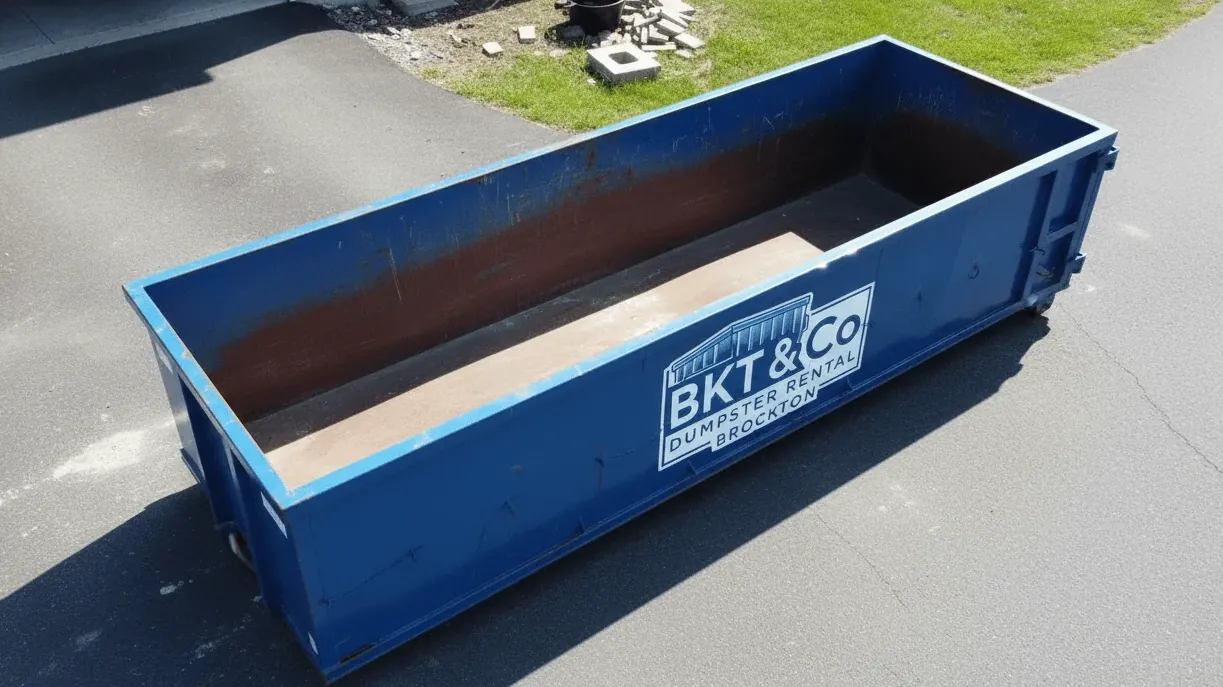
Drive north up Montello Street, or south along Main toward Campello, and you are looking at housing built for shoe workers that is still doing the job it was built for. Two households on a narrow lot, sometimes three, a full basement underneath and a driveway shared with the house next door. A turnover in one of these is nothing like a turnover in a garden apartment: everything the tenant leaves has to come down a staircase and out past somebody else's parked car.
Get the housing history right, because it decides the job
The authority on what Brockton built and when is the Massachusetts Historical Commission Reconnaissance Survey Town Report for Brockton, published in 1981. By the 1860s the standard working-class form here was the two-and-a-half storey, gable-roofed, sidehall-plan two-family house. Not a cottage, not a tenement block — a two-family, built to house one family and let the other half pay the mortgage.
The Late Industrial period, 1870 to 1915, was Brockton's most intensive residential construction, and the MHC is specific: two-family dwellings remained dominant, and three-deckers proliferated only after 1895, particularly in Montello and along Main Street south to Campello. The survey singles out Brockton's Queen Anne and Eastlake two-families for elaborate window treatment and varied siding, unmatched in eastern Massachusetts.
So Brockton is more of a two-family city than a pure triple-decker city. That matters, because general knowledge about Massachusetts multifamily is Worcester-flavoured, and Worcester is a triple-decker city in a way Brockton is not. Three-deckers here are real but late and concentrated. Budget a turnover from a triple-decker rule of thumb and you are budgeting for the wrong house on most Brockton streets. Older asphalt and asbestos-cement roofing and siding are also a genuine risk on stock this old, and we cannot take asbestos-containing material in any container, ever.
Why the housing exists: the shoe industry
In 1906 Brockton was described as the greatest city in the world for the manufacture of fine men's shoes. By 1910 the industry was worth $20.3 million and employed 12,183 workers; the peak came in 1920: 39 manufacturers, $102.5 million. Then production fell 49 percent between 1919 and 1929 and was down to $14.1 million by 1940, as southern states offered cheaper labour and tax abatements. Population peaked at 66,254 in 1920 and the building boom stopped with the payroll.
The housing built between 1870 and 1915 for those shoe workers is the housing being turned over today: plaster where you expect drywall, a full basement holding a century of somebody's storage, and floors carpeted, re-carpeted and vinyl-tiled over the original more than once.
What a turnover actually produces
Take it unit by unit rather than by square footage. A single unit, cleared properly, tends to produce:
- Flooring. Carpet and pad, and under it sheet vinyl over three or four earlier layers. The biggest volume surprise in an old house, because nobody counts the layers before pulling.
- Kitchen cabinets and counter — named by the City itself as material it will not collect, and bulkier than expected once the boxes are broken apart.
- A bathroom vanity, sometimes the tub with it, plus tile and pipe.
- Mattresses and left-behind furniture. Beds, a couch that would not go back down the stairs, a dresser missing a drawer. On an abandoned unit, the whole contents.
- Basement and attic storage. Massachusetts footings must reach a 48-inch frost line, so a full basement is nearly free once you have dug that deep and pre-war New England housing is essentially all full-basement. That basement has been storage for every tenancy since the house went up. Neither it nor the attic is on the lease, and neither empties itself.
A whole two-family — both units, plus the basement and attic — is a different order of job. Plan it as a cleanout that happens to be a rental. Our basement and attic cleanout guide works those spaces in detail, and estate cleanout is the service line for a long tenancy where the contents belonged to someone who has died or moved into care.
The banned-material trap that catches landlords hardest
Mattresses and textiles have been banned from disposal in Massachusetts since 1 November 2022, joining a ban list already running to fourteen other material streams under 310 CMR 19.017. The enforcement standard MassDEP publishes is not a threshold: "There is no acceptable amount of mattresses." One in a disposal load is a violation.
MassDEP also says who it is aiming at: enforcement targets businesses, institutions and haulers rather than individual householders. A landlord clearing an abandoned unit is a business. The tenant who left the bed behind is not the generator of that waste any more — you are.
The carve-out is real. Mattresses and textiles contaminated with mold, bodily fluids, insects, oil or hazardous substances are excluded, and MassDEP publishes a Contaminated Mattress Certification Form for documenting it, recommended rather than mandatory. On a unit that sat damp or has a pest history that is often the honest answer — but it is a documented exception, not a way around the rule for a clean bed.
| Material | Status | What it means on a turn |
|---|---|---|
| Mattresses and box springs | Banned since 1 Nov 2022, all generators | Count them before we quote. Contaminated units are excluded and can be certified. |
| Textiles | Banned since 1 Nov 2022, all generators | Clothing, linens and curtains out of a cleared unit. Pillows, cushions, rugs and shop rags are excluded. |
| White goods and appliances | Banned since 1991 | Fridge, stove and washer leave separately, not in the box. |
| Ferrous and non-ferrous metal | Banned since 1 Jul 2006 | Radiators, pipe, bed frames, storm doors. Pull them before loading. |
| CRTs and CRT televisions | Banned since 1 Apr 2000 | Only cathode ray tubes are listed; a flat panel is not a banned material. |
The full table and the local route for each material are in our Massachusetts waste ban guide.
Both the generator and the hauler are liable
Under the waste ban rules the people who generate solid waste and the people who transport it are both subject to the requirements. Facilities run random comprehensive monthly load inspections, and on a failed load the facility must notify the driver immediately and write to both the hauler and the generator within 45 days. Penalties run to $25,000 per violation per day for repeat, pattern or wilful violations. That is why we ask what is in the unit before we quote — the cheapest version of the conversation is the one before the box is on the driveway.
What the City will and will not take
Brockton's curbside collection is contracted to Republic Services, and the eligibility rule comes first. City collection is available only to residents of 1–5 family homes who pay the trash fee. Condominiums and businesses are not served by the city at all. For houses that do qualify, the allowance is narrow:
- One barrel per family unit per week, maximum 50 lbs. Beyond that, official green Brockton pay bags at $5 per roll of four.
- One free bulk item per unit per week, scheduled at least two business days ahead.
- After that, a $20 prepaid disposal fee each: mattress or box spring $20 all sizes, couch or loveseat $20, TV or computer monitor $20 all sizes.
Then the sentence that defines this market. The city does not collect construction debris or doors, and for items outside the programme — the City's own list names property cleanouts, automotive parts, bathtubs, kitchen cabinets, pipes, sheetrock, tree stumps, rocks, soil and asphalt — residents "must hire private haulers."
Cleanouts, cabinets, bathtubs, pipe and sheetrock are five of the ten items named. A three-unit turnover with four mattresses and a kitchen is not a bulk-item job by any reading of the city's rules. One free item a week against four mattresses is a month of Tuesdays, at $20 each after the first, with the cabinets still in the yard because the city will not take them at any price.
Condominiums: the driveway may not be yours to give
If the house has been converted to condominium ownership, placement becomes a legal question. Under M.G.L. c.183A §5 the common areas are held by the unit owners in undivided interests, and in a small converted house the driveway, parking area and lawn are almost always common area. So a unit owner cannot unilaterally authorise a container there — the trustees have to consent. Get that in writing before the delivery date, not on the morning the truck is scheduled. The statute is on the Massachusetts General Laws site.
Placement on a Brockton lot, and the ten-foot rule
The typical Brockton two-family sits close to its neighbours with a driveway down one side, often shared. That driveway has a bulkhead opening onto it, the downstairs tenant's car on it and a fence at the end. Then the fire code arrives.
527 CMR 1.00, the Massachusetts Comprehensive Fire Safety Code, Table 1.12.8.5 lists rubbish containers over 6 cubic yards as a permitted activity, with the head of the fire department as issuing authority. Every standard roll-off is over 6 cubic yards, so a fire chief's permit is required for essentially any container left overnight, on private property or public. One delivered and removed within a single business day is exempt. The placement rules Massachusetts departments publish under that chapter:
- At least 10 feet from combustible walls, openings and combustible overhangs. The International Fire Code, used in most other states, says five. Massachusetts enforces ten under NFPA 1, and most dumpster content online quotes the five.
- Not within 20 feet of an intersection, not within 10 feet of a fire hydrant.
- If adjacent to a building, the top of the container at least 5 feet below any window.
- No blocking fire apparatus access or egress, nothing under a fire escape, and the container marked with a company name and emergency number.
On a dense Montello or Campello lot the 10-foot rule is usually the binding constraint, not the length of the box. A driveway measuring twelve feet wall to fence does not contain ten feet of clearance, which is why some of these jobs need a conversation first. The permit is commonly pulled by the property owner or lessee, which for a landlord means you. Brockton Fire Prevention is 508-583-2933 — call and confirm how they handle it for your address.
Seasonality: turnovers cluster, and winter makes it worse
Turnover work follows lease dates rather than weather, so it clusters — tenancies end on the same handful of dates and everybody wants a container the same week. Booking a fortnight ahead gets the day you want.
Winter adds a problem the calendar does not show. A driveway that is tight in July is tighter with a plough windrow across the apron and a snowbank down one side, and the truck needs room to tilt the box up as well as set it down. Clear the placement area before the delivery window. Spring has its own gap: Brockton's curbside yard-waste route does not start until early July, so brush and leaf piles from a spring turnover have no curbside route until then.
Sizing a turnover
- A single-unit turn — contents, carpet, a few mattresses, maybe the vanity — is usually a 15 yard or a 20 yard. Take the 20 if the kitchen is coming out.
- A whole two-family, both units plus basement and attic, is a 30 yard. Two units of contents plus a century of basement storage is not a 20.
- Keep clean gypsum wallboard out of the mixed load. MassDEP requires facilities to separate wallboard before transfer, so a load with loose sheetrock in it gets priced or refused accordingly. If the turn includes drywall repair, stack it separately.
Where the labour rather than the container is the problem — an abandoned unit, a third-floor walk-up, nobody to carry it down — junk removal covers the loading. A single house is a residential roll-off; a management company running units on a rolling schedule, or any building the city does not serve, is what commercial service is set up for. The bulk-item and eligibility rules are published by the City of Brockton, the waste bans and the certification form by MassDEP.
BKT & Co Dumpster Rental Brockton has run out of the yard at 1109 Montello Street since 2011. Brendan Teixeira started with one truck and four cans and still answers the phone. Tell him how many units, how many mattresses, whether the kitchen is coming out and whether the driveway is shared, and he will size it. Call (508) 436-2303 or use our contact page.
Questions this guide did not answer? Call (508) 436-2303. We would rather spend two minutes on the phone than have you order the wrong container.