
Estate Cleanout
Estate Cleanouts in Brockton, Massachusetts
Unhurried work on houses that have often been held by one family for three or four generations. We pull the salvage first, keep the restricted material out of the load, and work to the family calendar rather than ours.
Most Brockton estate work happens in a house built between 1870 and 1915. The Massachusetts Historical Commission survey describes that period as the city most intensive residential building, with the two-family dwelling dominant throughout and three-deckers proliferating after 1895, particularly in Montello and along Main Street south toward Campello. A great many of those houses have never left the family that bought them. That changes the pace of the work: the sorting matters more than the hauling, and nobody benefits from a crew standing in the hall while decisions get made. Our estate cleanout checklist is written to be worked through slowly.
The salvage comes out before the container does. Houses of this era carry period door hardware, mouldings and newel posts, marble and carved wood mantels, cast iron radiators and clawfoot tubs, and in the Queen Anne and Eastlake two-families the survey singles out for their window treatment, joinery worth keeping. There is a practical reason as well as a sentimental one: ferrous and non-ferrous metal has been off the Massachusetts disposal list since 1 July 2006, so the radiators and the tub have to leave the load anyway. Pulling them deliberately is simply better than discovering them at the scale.
Then the ordinary contents. A full cellar, an attic, and in a two-family or a three-decker the same again on the floor above. Bedrooms are where the plan usually breaks, because mattresses came onto the disposal ban on 1 November 2022 and cannot ride in a disposal load. The other thing to settle early is who is standing at the gate: an executor who does not live in the house may not qualify for resident pricing at the Recycle Depot. See the two-family turnover guide for how these buildings empty.
How An Estate Cleanout Runs Here
Sorting Before Anything Moves
Keep, sell, donate, dispose. We stage the container after that decision rather than before it, because a box in the drive puts pressure on a family that does not need any more of it.
Period Hardware And Millwork
Rim locks, escutcheons, hinges, mouldings, newel posts and panelled doors. Worth a phone call to a salvage buyer before a single one of them goes near the box.
Marble And Wood Mantels
The Queen Anne and Eastlake two-families the state survey praises for their detailing usually still have theirs. Heavy, fragile and genuinely saleable, so they come out by hand.
Cast Iron Radiators
Beautiful, extremely heavy, and metal, which has been off the disposal list since 2006. They leave as scrap or as salvage, never as part of a general load.
Clawfoot Tubs And Fixtures
A cast iron tub is the single heaviest thing most of these houses contain. It has a resale market and it is a restricted material, so it goes out on its own route.
Bedrooms And Mattresses
The one that catches people. Mattresses cannot go in a disposal load at all, so we count them at the walkthrough and plan the route before the container is booked.
The Full Cellar
Decades of stored contents under the whole footprint, often damp, often on a fieldstone wall. Wet cardboard and wet timber weigh far more than they look.
Attic, Trunks And Paper
Documents, photographs and correspondence that should be read before it is binned. This is the part of the house that most rewards taking an extra weekend over it.
Sizing An Estate Container
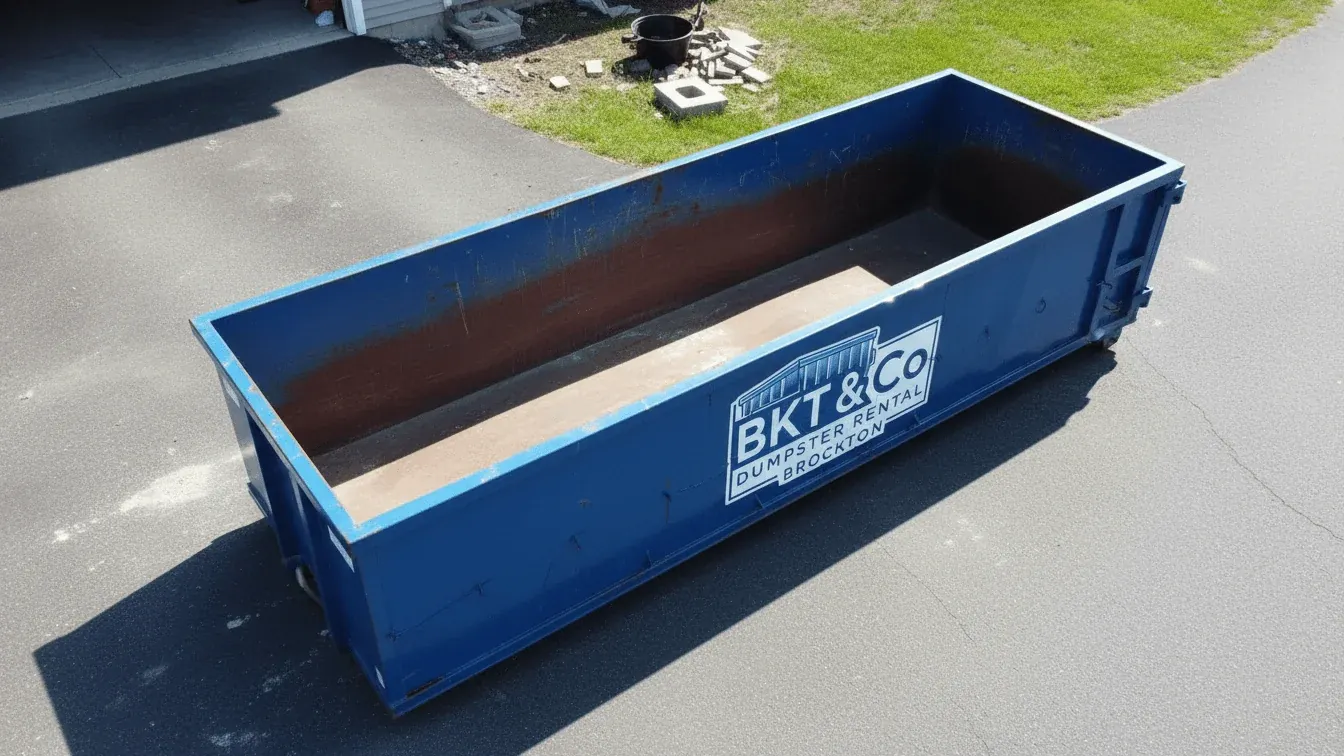
A single-floor estate cleanout in one unit of a two-family usually lands on a 15 yard, which also has the advantage of fitting on the short side drive these houses were given long before two cars per household. A whole house, cellar to attic, is generally a 20 yard, and that is the size we set most often on this work. A three-decker cleared in one pass, or a two-family where both units and the cellar go at once, is a 30 yard or a 20 swapped twice, and the swap is often the better answer because it keeps the box off a narrow street for less time. Damp cellar contents, plaster and books move everything one size down. Radiators, tubs and appliances do not count toward the box at all, because they leave on a separate route.
15 Yard Dumpster
A single room, a small tear-off, or one unit of a two-family turnover.
View this size →20yd³20 Yard Dumpster
A full basement and attic clear-out — the New England default — or a multi-room remodel.
View this size →30yd³30 Yard Dumpster
A whole two-family or three-decker with basement and attic, or a large remodel.
View this size →Salvage, Restricted Material And The Executor Question
Three things shape an estate job here that would not shape one elsewhere. The first is salvage, which is partly a disposal question: metal has been restricted since 1 July 2006, so radiators, tubs, boilers, cast iron sinks and pipe have to leave the load whatever you decide to do with them. Pulling them first turns an obligation into a small recovery. The second is mattresses. MassDEP has put it as bluntly as a regulator can, saying there is no acceptable amount of mattresses, and the ban has covered all generators since 1 November 2022. The narrow exclusion covers items contaminated with mould, bodily fluids, insects, oil or hazardous substances, and MassDEP publishes a Contaminated Mattress Certification Form for it, but that form is recommended rather than binding, so ask the facility and do not assume. The third is the oil tank, common in these cellars. Brockton Fire issues the FP-292 permit at published fees of $55 residential aboveground and $100 underground, and a release over 10 gallons needs notification within 24 hours, sometimes within 2, under the Massachusetts Contingency Plan, 310 CMR 40.0300.
Not sure this is the right service? Describe the job on the phone and we will point you at the right container even if it is a different service page. Call (508) 436-2303.
Get a flat quote
Two minutes on the phone gets you a size, a price and a delivery slot. No forms.
(508) 436-2303Recommended sizes
How it works
Estate Cleanout Dumpsters in four steps
- 1
Call us
Tell us the project, your address and when you want it. Two minutes on the phone and you have a flat price.
- 2
We deliver
Our driver walks the drop, lays protection boards and sets the container exactly where you want it.
- 3
You load it
Take your time within your rental window. Keep it level with the top rail and we handle the rest.
- 4
We haul it
Call or text when you are done. We pull it, sort what can be recovered and dispose of the rest properly.
Estate Cleanout Dumpsters FAQs
The house has been in the family for generations. Where do we start?
With the paperwork and the small rooms, not the cellar. Work keep, sell, donate, dispose room by room, finish the attic papers before anything else is touched, and only then book a container. The reason is practical as much as emotional: once a box is on the drive there is pressure to fill it, and estate contents in a Brockton two-family routinely include period hardware, mantels, radiators and a clawfoot tub that have a genuine resale market. We would rather come back for a second box than watch a family put a marble mantel in the first one. Our estate checklist gives you an order to work in, and we are happy to walk the house before anything is scheduled.
What should come out before the container arrives?
Anything with a salvage market and anything the state will not let us dispose of, which turns out to be much the same list. Period door hardware, mouldings, panelled doors, newel posts, marble and carved wood mantels, light fittings, and the cast iron: radiators, clawfoot tubs, sinks, boilers and pipe. Ferrous and non-ferrous metal has been off the Massachusetts disposal list since 1 July 2006, so the iron has to leave the load in any event, and a scrap route or a salvage buyer is simply a better ending for it. Add mattresses to the separate pile, along with textiles, appliances, televisions and monitors, cardboard and books. What is left after all that is what the container is for.
There are five mattresses in the house. What happens to them?
They do not go in a disposal load. The Massachusetts mattress ban has applied to all generators since 1 November 2022 and MassDEP describes the standard as there being no acceptable amount of mattresses, meaning a single one in a load is a violation. The exclusion is narrow: mattresses contaminated with mould, bodily fluids, insects, oil or hazardous substances fall outside the ban, and MassDEP publishes a Certification Form for that, but the form is recommended rather than mandatory and the receiving facility decides, so ask them first. Mattress pads and toppers, waterbeds and futons are also outside the ban. City kerbside will take one bulk item per unit per week free with two business days notice, then $20 each for a mattress or box spring.
I am the executor but I do not live in Brockton. Does that matter?
It can, and it is worth settling before you drive anywhere. The Brockton Recycle Depot at 300 Oak Hill Way is a residents-only facility for resident pricing and asks for proof of residence at the gate, so an executor with an out-of-town licence may not be treated as a resident even though the estate property is in the city. Non-resident pricing is published for some streams, for instance $8 a gallon for paint. Call the Depot on 508-580-7827 before you load a car, explain that you are settling an estate at a Brockton address, and get the answer from them rather than from us. The Depot is open Monday to Saturday 8:30am to 3:00pm and takes no construction debris at all.
There is an oil tank in the cellar and a stain on the floor.
Stop and make two calls. Brockton Fire Prevention on 508-583-2933 issues the FP-292 Tank Removal Permit, with published inspection fees of $55 for a residential aboveground tank and $100 for a residential underground tank, and the fire department is also the first call if there has been a release. MassDEP requires notification for a spill of more than 10 gallons of oil within 24 hours, for any quantity creating a sheen on surface water, for oil on the groundwater table, or for petroleum vapours in a building, and notification can be required in as little as 2 hours. The controlling rule is the Massachusetts Contingency Plan, 310 CMR 40.0300. MassDEP also warns that many insurance policies carry a pollution exclusion, so read the policy early.
More services
Other things we haul
Residential Dumpster Rental
Driveway placement for full-basement, attic, porch and shed cleanouts and remodels.
Learn more →Commercial Dumpster Rental
Containers for businesses and condominiums, which the City does not collect from at all.
Learn more →Construction Dumpster Rental
Jobsite roll-offs routed to a permitted C&D processor, with next-day swap-outs.
Learn more →Roofing Dumpster Rental
Weight-rated cans sized by squares and layers for asphalt shingle tear-offs.
Learn more →Roll-Off Dumpster Rental
10, 15, 20, 30 and 40 yard roll-offs across Brockton and the South Shore.
Learn more →Same-Day Dumpster Rental
Call before the cut-off and we can usually get a container to you this afternoon.
Learn more →Junk Removal Dumpsters
Clear a full basement, attic, porch or shed on your own schedule.
Learn more →Demolition Debris Removal
Containers and fast swaps for porches, decks, sheds, garages and interior gut-outs.
Learn more →Concrete & Heavy Debris
Dedicated heavy cans for concrete, brick, plaster and foundation spoil.
Learn more →Yard Waste & Brush Removal
Separate clean loads — Massachusetts has banned yard waste from disposal since 1992.
Learn more →Where we deliver
Estate Cleanout Dumpsters across Plymouth County and the South Shore
Same service, same flat rates, every town below. Pick yours for local placement and permit notes.
Talk to a real person
Need estate cleanout dumpsters in Brockton?
Tell us what you are clearing out and we will tell you the right size and the flat price to put it in your driveway. No forms, no waiting on an email — just call and we will sort it out in a couple of minutes.
Serving Brockton, Plymouth County and the South Shore · Mon–Fri 6:30am–5pm, Sat 7am–1pm